|
Privet! I am officially back at MIT! I've been up for about 25 hours on only 3 hours of sleep, so I'm quite content to write this final post from the comfort of my own room while enjoying a cup of a tea. It was a fairly uneventful trip back, with some pleasant surprises. First, I bumped into two other MIT students (Marvez and Neeraj) in GTL Russia at the Moscow airport! We were all on the same flight back to JFK, and Marvez and I were on the same flight from JFK to BOS. I was very glad for the company, especially since Marvez and I had a very short layover in JFK... In the span of about two hours, we deplaned, went through customs, picked up our checked luggage from baggage claim, re-checked our luggage to Boston, printed boarding passes, and got through security. I was really nervous that we weren't going to make it, but everything worked out in the end! We even had 20 minutes to spare. On the plane ride from Moscow to JFK, I also watched this really awesome new Russian movie called "Время Первых" (Vremya Pervykh, Time of the Firsts), but the movie translated the title a bit differently, as "Spacewalk." It was like a Russian version of The Right Stuff! The movie followed cosmonaut Alexei Leonov as he became the first human to complete a tethered spacewalk. There was an interesting depiction of tension between the military and scientific folk involved in the space program. To finish off my daily blog and provide some final thoughts, I would like to share this “Post GTL Report,” summarizing my experience and helping me process and introspect about my trip and what I learned. Introduction This January, I traveled to Perm, Russia to teach at the Alexander Pushkin School #9 for about three weeks. I was guided and helped by Maria Okulova, a teacher and coordinator at the school. I taught five groups of 9th, 10th, and 11th grade students. Most groups had one lesson per week (three lessons total), and one group had two lessons per week (six lessons total). I wanted to share my passion for airplanes and rockets with the students. MIT’s motto is Mens et Manus, or Mind and Hand, so I wanted to teach the students in a fun and interactive manner that differed from their day to day classes. Therefore, I decided to focus my lessons on experiments and activities. The students conducted experiments to learn about fundamental concepts in aerospace engineering, such as thermodynamics, forces of flight, and Bernoulli’s principle. To conclude the lessons, the students built and launched water bottle rockets. The classroom was very loosely structured. I spread materials all around the room, and had students stand up and walk around to conduct various experiments and build their water bottle rockets. Students also practiced team work, because many of them worked on small teams of two or three students to build their water bottle rockets. I encouraged the students to talk with one another, ask questions, and think creatively! What were some challenges of living and working in Russia? Did you feel sufficiently prepared to meet them? How did you deal with them? I loved living and working in Russia. I have been studying Russian language (and, by extension, Russian culture) for the past three and a half years. This interest in Russia was initially motivated by my trip to Moscow in 2012, and then by my dream to be an astronaut! It was absolutely amazing to return to Russia as a more mature and knowledgeable person, and experience the country now that I have a background in the language and culture. Fortunately, I did not face many challenges in Russia. First was the language barrier. Even though I have some knowledge of the language, I quickly realized that my weaknesses are vocabulary and listening comprehension. In other words, when native Russian speakers talk to me, I don’t always understand what they are saying. Then, I don’t always have the right vocabulary to answer them. This was an interesting dynamic in the classroom. The students at the school have studied English since the first grade, but not all of the students are at the same level with English. I often had to rely on some students to help me translate uncommon words, especially technical words. Once, I asked the students if they thought the outcome of the experiment would be ‘A’, ‘B’, or ‘C.’ After a short pause and some blank stares, they hesitantly answered, “yes?” In situations like this, I could use my limited vocabulary to explain what I meant in Russian, or asked students for help translating. I also tried to avoid this situations by preparing examples and explaining with drawings or pictures rather than words. For example, when the students were building their water bottle rockets, I built a rocket as well so that the students could see the process and building techniques themselves. I also asked the students frequently if they understood the topic, or if they had any questions. I tried to explain complicated or uncommon English terms, and explain things multiple ways. The other big challenge I faced was dressing appropriately for the weather. The average temperature we saw in Perm was close to -15 degrees Celsius, and it was often windy or snowing. This is much colder than in Boston! Fortunately, I had my winter gear from my trip to Kazakhstan in the previous winter. This gear kept me quite warm. One small challenge I faced was adapted my lesson plans to the schedule once I arrived in Perm. Based on my GTL experience in Kazakhstan last January, I was expecting to teach for four hours a day. So, I had prepared a large amount of material for the students. In the final schedule, I taught each group of students for a total of about two and a half hours. I had to make drastic modifications to my lesson plan, including cutting some planned activities, and consolidating the concepts I wanted to cover. What did your MISTI experience teach you about working in a different country and culture? In what way was the work culture different from what you have experienced before? How did this impact your capacity to accomplish your tasks? My GTL experience taught me that working in another culture and country can be exciting, educational, and rewarding. It was exciting to visit another country and learn about their culture and history. It was incredibly rewarding to teach in Russia because I brought the students not just new knowledge, but a new way of learning as well. While several physics classes in School #9 conduct experiments, it is still not very common. By structuring my lessons about experiments and activities, I exposed the students to a new classroom experience. One student personally thanked me for the hands-on and engaging lessons after the class. Teaching about aerospace in Russia was particular y fun because, like America, Russia’s space program has a long history, and Russian citizens are proud of their achievements in space. I was able to teach them about my own culture and life just as I was learning about life and culture in Russia. I also learned that it is important to have several methods of explaining concepts prepared, especially when working in another country with a different language. Pictures and drawings are particularly useful for overcoming language barriers in the workplace. I also learned about many similarities between Russian and American schools. In both countries, the teachers work very hard! There is a lot expected of teachers, and they work hard to prepare good lessons for the students. The teachers were all very polite and nice to me as a fellow teacher and guest. This made it very easy for me to accomplish my tasks and lead my lessons, because if I ever needed help, I only had to ask for it! The teachers were all very accommodating and understanding. One major difference I noticed was that students and teachers had closer relationships that in the U.S. like good acquaintances or friends. This also made our visit very exciting and fun, because students would take us to cafes and on excursions to attractions and museums around the city. Some differences in the culture is that the students study for fewer hours each day, but for six days a week. Half of the students study in the morning (first shift) and the other half study in the afternoon (second shift). The students do not have a strictly enforced or official dress code in the older grades, but they are encouraged to dress nicely to school, and many students attended class in business casual or business attire. The students also stood to greet teachers when they enter the room. What did you learn about yourself during your MISTI experience? How did his experience influence the path that you’ll take back at MIT and beyond? I learned about myself as well during my GTL experience. First, I realized that I need to improve my Russian listening comprehension and vocabulary. I plan to studying vocabulary more rigorously this semester by using flashcards on Quizlet. I will not be taking a Russian language class this semester, but I will practice listening comprehension by listening to Russian music, watching Russian TV shows, and attending “Russian Table” speaking practices at MIT. I also learned that it is much easier for me to teach in shorter periods of time about topics that I am truly passionate about. In Kazakhstan, it was challenging to fill the lesson time with meaningful and engaging material about the scientific process. The scientific process is important and valuable to understand as an engineer, but I was really interested in teaching the students about aerospace. Therefore, this year was much easier for me to prepare and teach lessons! I now know some fun and effective experiments and lessons to help teach people in the future about basic aerospace concepts. I picked up some useful teaching tips that worked very well for me as a teacher. As mentioned earlier, pictures and examples are valuable teaching tools. It’s also critical to practice giving lessons and conducting experiments before class to ensure that everything runs smoothly. My 11th grade group was often my “guinea pig class,” because I would give them a lesson for the first time. In my very first class, which was taught to the 11th graders, I discovered during class that three of my activities did not work! This was the worst way to realize that something was not going according to plan. The next couple of days, I spent my free time testing out my other experiments and activities, and discovered ahead of time some that did not work, and suitable replacements for those activities. I also affirmed that I really enjoy sharing my passions with other people, in a way that they feel successful and excited too. Launching water bottle rockets with the students was particularly rewarding. When I return to MIT, I will continue outreach events with the MIT Rocket Team to teach students about rocketry. When I graduate MIT, wherever my path leads, I want to continue helping with outreach events to get young students excited and engaged in space and aerospace engineering. What did you get out of working in Russia through MISTI that wouldn’t have happened had you stayed at MIT or in the US? Teaching in Russia was an incredibly valuable experience that brought me opportunities I would not have had in America. First and most obviously, I had the chance to live and work in the country that I have been studying for my minor for over three years. I was able to experience and learn about Russian culture and history firsthand, with my own eyes and ears. This was incredible important because I had cycles of validation. In the Gordon Engineering Leadership program, I learned that cycles of validation are important for learning. A concept is introduced, and then it is reinforced (or validated) when the student is able to practice or engage with the material in a thoughtful or memorable manner. For example, I learned in class at MIT that Russian people are very hospitable and love going to banya. This knowledge was validated when I traveled to Russia, and experienced true Russian hospitality, and went to banya with Russian friends. Secondly, I demonstrated that I truly understand concepts in aerospace. I believe that one truly understands material when one can explain it to another person. This January, not only did I teach a class about aerospace concepts, but I taught it to students who are non-native English speakers. For me, this is a sign that I truly understand the material I taught! Do you have any advice for future interns on life in Russia, working with the host, expectations, planning, etc.? I would advise future GTL students to ask their host any questions they have in order to prepare for the trip. Consider things like: how many students will you be teaching? What age are the students? What topics will you be teaching? How long are the lessons? How many lessons will you be teaching? What resources will you have as a teacher (printer, projector, chalkboard, paper, pencils, etc.)? Similarly, I think it is better to be over-prepared for the lessons: make sure to bring any specialty materials or items that will be hard to find, prepare more material than you expect to use, and be sure to demo your material and lessons as much as time will allow. I would also advise future students to not pack their suitcases full on the outbound trip, because they will likely have many souvenirs on the return trip! Also, be sure to pack a swimsuit… even if you are going to Russia in January! What is one specific experience from this IAP in Russia that you’ll never forget? Thanks to the hard work of our host school, I had an incredible trip with many memorable experiences. I especially loved (in no particular order) making traditional Perm Krai gingerbread, visiting the Aviadvigatel aviation museum, and going to Russian banya. Making gingerbread was an amazing experience because I felt very welcome and at home in our teacher’s house. I felt successful and proud that I was able to communicate with native Russian speakers and have intelligent conversations with them. I also loved learning about a tradition local only to Perm. Ending the evening with accordion-accompanied song was amazing! It was just like in the classic Soviet films I have watched, and I was touched to be a part of that traditional Russian experience. Naturally, I loved the aviation museum. I have been to so many American aviation museums, but I have never been to a foreign aviation museum. I enjoyed learning about Russian aircraft engines and the history behind the factory and its directors. It was also quite moving to hear how Russian and American aviation companies worked together in times of trouble. Going to Russian banya was another traditional Russian experience that I was honored to take part in! It’s a cultural phenomenon that I had previously only seen in movies, or heard about from my teachers. To experience it firsthand was culturally interesting, and I understand now why it is so popular in Russia! Summary My Global Teaching Labs experience in Perm, Russia was incredible. I loved sharing my passion for aerospace engineering with the students, and launching water bottle rockets with them. Living in Russia while I taught was invaluable for me as a student of Russian language and culture, and I had a blast experiencing Russia firsthand!
0 Comments
Privet! Today was my last day in Perm... and what a day it was! Cole and I had two lessons today. The first was in the morning, and my students had a blast launching their rockets! We had a short break for breakfast (chicken cutlet and pasta) and some work, then we had a second lesson in the early afternoon. Again, I blast launching rockets with the students, and we experimented with different amounts of water to load into the rockets. After the second lesson, we had lunch in the school canteen. Today was a delicious vegetable and potato soup (with a dab of sour cream of course), then some chicken with buckwheat and tomatoes and cucumber. After lunch, we met with some of the 11th grade students and went bowling! the bowling alley was near the school. It was very clean, and they played good music! I did decently, but could tell when my arm started getting tired. We bowled for a couple hours, then returned to the school for dinner. We had a really tasty chicken and green bean dish, served in a ceramic pot. It reminded me of the first meal Cole and I had with Masha and Olga when we arrived in Perm - everything comes full circle! After dinner, we participated in a Trivia Night put on by the school. It was about Russian and American culture. Cole and I were on a team we called The Americans (of course!) The questions were about famous Russian immigrants to America, American Grammys, American literature, and miscellaneous trivia. Turns out, Cole and I won! After trivia, Cole and I exchanged gifts with the remarkable people who made our experience here so memorable: Masha, Olga, and Natalya (the director of the school). There were smiles and hugs all around! Then, Cole and I enjoyed tea and snacks with the students from Trivia Night one last time. We bid the students a fond farewell, then met the IT teacher Galina and walked with her to her home. We visited her and her family for a little bit, and enjoyed some more tea and cakes. Then, Galina and her daughter Masha walked Cole and I back to our hotel. It was a 20-30 minute walk, and there was a light beautiful snow! It was so pleasant. I talked with Galina the entire walk back in Russian, and felt very successful for having such a long and intelligent conversation in Russian! I just finished packing up; I couldn't pack earlier because I needed to pack some last-minute supplies from my lessons today! Now, I am going to take a short nap before waking up at 3:30am to catch my flight back to Boston! It has been an incredible trip, and I cannot possibly explain my feelings of gratitude, success, contentedness, and adventure in this short blog post! But, keep your eyes peeled for one final post when I land back in Boston... Do Zavtra, and for the last time from Perm, Piper Privet! Today was an awesome day. We didn't have lessons until later in the morning, so we got to sleep in a bit. We had breakfast at the school this morning, a delicious chicken and potato bake. My first lesson pretty hectic, since a lot of the students had to build their rockets still! We build many rockets in about 25 minutes, then dashed outside to launch. Everyone except 1 student had time to launch (but that was because I had her run back inside to get more water). By the time we got back inside and I cleaned up the room, it was time for the second lesson. These students had their rockets already built and ready to fly, so we had a much more leisurely lesson. We went outside and launched, and some students launched a couple times. After the lesson, we had lunch in the school canteen. Today's soup was chicken noodle, and we also had a sort of meatloaf-meatball with rice. To drink, we had apricot compot. It was quite tasty! After a quick lunch, Cole and I met Olga, one of her students, and Svetlana, an employee of Авиадвигатель (Aviadvigatel, Aviation Motors). Aviadvigatel is a large part of Perm's history, dating back to the 1920s. Their factory is located a short distance from the school, so we went to take a tour of their small history museum. It is uncommon for foreigners to visit, and it took a lot of effort for Olga and Maria to arrange the trip, so I am so thankful that we were able to go! The museum was on the Aviadvigatel campus (hence the trouble to arrange the trip), which reminded me a lot of a NASA campus. It was almost like a small town or city, with many buildings, roadways, cafes, and even a hotel. The museum included information about the history of the museum and factory itself, various aircraft engines, and important people in the history of the factory. First, some history... The factory first opened in the 20s. A delegation went to America to learn about aircraft engines, and bought the rights to a Curtiss-Wright engine. Their engineers modified the design a bit, and this became the first engine to be produced in the factory. Having a starting point was very useful for the Aviadvigatel engineers to learn about engines and how to design and manufacture them. When the Great Depression hit America in the 30s, the factory bought the rights to more engines from American companies at a very reasonable price. Again, this acquisition helped the company learn more about aircraft engines. The factory has made engines for both civilian and military aircraft, as well as rocket engines during the 60s. The factory was also instrumental to the success of the Russian military in WWII (the Great Patriotic War). In fact, the factory was permanently awarded a commemorative flag in honor of their service to Russia... after winning the award for 19 years in a row! The flag was displayed in a corner of the museum called "the red corner," where the museum displayed Книга Почета (Kniga Pocheta), or Books of Honor. These books are like fancy "employee of the month" plaques, and honor the best workers in the factory. The corner was literally painted red, and I was intrigued that the books bore a picture of Lenin's bust. During the Great Patriotic War, a large percentage of Russian men left home to fight. This meant that there were not enough people to produce engines in the factory. So, the factory began employing children (older than 11) and women. The director of the factory at the time was very kind towards the children who worked there, and built them comfortable housing and gave them gifts. Towards the end of the Soviet Union, the factory had a challenging time paying its workers. An American company, Pratt and Whitney, noticed their plight and donated $3 million to Aviadvigatel to help them. Throughout its long history, Aviadvigatel has been an important part of Perm, responsible for creating housing and bringing jobs to the Perm area. It started off situated at the edge of the city, but as Perm grew, the factory now sits in the city center, an apropos position given its important history in Perm. Many Perm citizens are quite proud of the factory, and always mention it to me when they find out that I am an aerospace engineer! Now, for the engines! Other than the designs bought from America, all of the engines are designed and built by Aviadvigatel. The museum displayed rotary internal combustion engines, jet engines, and some cool helicopter engines too! Each engine displayed was both built in the factory and flown on an aircraft. They were displayed with statistics painted on the walls behind them, like mass, horsepower, years in operation, and (my personal favorite) awesome silhouettes of the planes that used the engine. I thought it was a very effective and cohesive display. Our tour guide only spoke Russian, so Olga and her student helped us translate, but there were several times where I was able to chime in with a technical vocab word to help :) One of my favorite displays was a small section devoted to the factory's history building rocket engines. I also really enjoyed the jet engine that was partially cut-away like a cross section. There were some really neat displays with the evolution and manufacturing process of compression blades as well, and I thought it did an excellent job demonstrating the intricate and complex process. Overall, the museum was phenomenal. I couldn't stop smiling the whole time! I really enjoyed hearing how the Russian and American companies Aviadvigatel and Pratt and Whitney worked together. It reminds me why I love the aerospace industry so much! In spite of politics and business competition, people from across the industry pull together and collaborate for the sake of science and progress. I also thought it was interesting to learn about a recent director of the factory, who was known for emphasizing creative thinking. The director stressed that engineers and designers must think 20 to 30 years in advance when designing engines. This is very wise because the design and development cycle for aircraft is so long - a single aircraft might be in service for 100 years. It also made me smile because this same methodology is commonly seen in the American aerospace industry. For security reasons we weren't allowed to bring phones inside, but Svetlana took pictures and I will post some as soon as I have them! We said goodbye to our hosts at the museum, and Svetlana drove us back to school. Masha, Olga, and I took a quick but relaxed tea break. Then, I coordinated and met with the student this morning who did not get to launch, and we launched her rocket a couple times. I'm glad she was able to launch in the end! Cole and I had dinner at the canteen. It was tasty meatballs and rice. Cole had an interview in the evening, so I met with the student Fyodor and his mom, and she drove us to see a concert. The music hall was beautiful; it was on Lenin Street, just up the road from our hotel. The music hall appeared to be an old apartment building, or factory perhaps, that was renovated. The walls were beautiful exposed brick, and you could see where there had been windows before. The first piece in the concert was a sonata for viola and piano by Dmitry Shostakovich. The second piece was a sonata for violin and piano by Cesar Franck. I think the second piece was my favorite; I want to listen to it again! Fyodor's family dropped me off at the hotel after the concert. I am anxious for my last day tomorrow... Two more sessions of rocket launching, then some final activities planned to bid our school farewell. I'm going to try to get to sleep early these next couple of nights, because I will need to wake up around 3:30 am on Saturday to catch my flight! Do Zavtra, Piper Privet! Today was a very busy day! Cole and I woke up early this morning to watch the State of the Union Address. It was quite interesting to watch American news from Russia. We didn't get to watch all of it, however, because we had to get ready for school. Masha drove us in like usual, and we taught a lesson in the morning. I taught my two-lessons-a-week group today, so they just built their rockets this lesson. There are not many students in this group, and they worked on small teams or by themselves to build a rocket. The students also picked up the construction techniques pretty quickly (because I taught them some of the basics last class) so they had plenty of time to build their rockets and chat with me a bit while we worked. They will launch tomorrow morning! After class, we had a nice tea break in the school canteen, then after her lesson, Masha took me and Cole to a nearby cafe called September. We had the most amazing hot chocolate ever. It was called звездный какао (zvezdny cacao, Star Hot Chocolate). It was served to you in a Star Wars themed mug, while the barista played the Imperial March over the cafe's speaker system. Again, best hot chocolate ever. We went back to school, and had lunch (but no tea this time!). Today we had borscht (yum) with noodles and pork. Then, Cole and I met with Sasha and Dasha. Sasha is a graduate of School #9 and now studies international relations with Dasha in Moscow State University. We went to a cafe near the school called Violet, and I had a delicious latte. Then, we walked to an escape-the-room place called Lost. It wasn't too scary, but it was very challenging since a lot of the clues were in Russian! We were able to solve the room with three hints :) Dasha and Sasha took us back to school, where we had dinner in the canteen: rice and fried chicken stuffed with mushrooms and onions. I am really going to miss the delicious food here... Then, we went ice skating with some of Masha's and Olga's 7th grade students! The ice rink was very fun. I particularly enjoyed skating to Russian music! It was also not as crowded as I thought it would be. I missed my own pair of ice skates, but the rentals here were not too bad. They had a sort of plastic shell, so there was good ankle support, but the blades were a bit dull. After the rink, Masha drove us back to the hotel. Cole and I wanted to grab a bite to eat since we had an earlier dinner, so we met Anna and Sasha at a McDonalds (of all places!) near our hotel. In honor of the super-blood-blue-moon eclipse today, we traded some space themed words! I also pointed out the Orion constellation (one of my favorites!) to Anna and Sasha on our way back to the hotel. Some of my favorite words that I learned: Полнолунье (polnolunie) - lunar eclipse Освещать (osveshat) - to shine (as in, the moon shines on the sidewalk) Созвездие (sozvezdie) - constellation (literally translates as "with stars") All the space talk has me even more excited to launch rockets with the students tomorrow! Do Zavtra, Piper Privet! What an exciting day! I started the day with breakfast in the hotel, where I bumped into a very interesting person: an opera singer from Canada, who lives in Connecticut, and is in Perm performing at the opera! It was a great coincidence to hear another native English speaker. Maria picked up Cole and I and drove us to school, and showed me how to get to the backyard of the school for my lesson today - launching rockets! It was a hectic lesson, but everything turned out great in the end. We spent the first 20 minutes or so of class finishing rockets, then put on coats and hurried out to the yard. There was enough time for each group to launch their rocket once, and one group launched twice. It was so exciting, and all of the students had a great time! We also had an audience - younger students and teachers watched us launch from the windows and cheered on each launch. After the lesson, I cleaned up and came inside, and warmed up with a nice cup of tea. I also had a small pastry; it was bread stuffed with delicious cheese. Then, Andrei met me and Cole and took us to see Перевернутый Дом (Perevernuty Dom, Upside Down House), a famous attraction in Perm. I was expecting a museum or gallery of unique and eclectic photos, but it was literally an upside down house. There were four rooms, and two floors. It really played tricks on my brain, since the floors and walls were slanted at an angle. I felt like I walked into The Twits, by Roald Dahl. We went back to school and enjoyed a tasty lunch. We had vegetable and potato soup, and chicken kebab served with mashed potatoes. Iulia stopped by to say hi, and I showed her and Cole how to build water bottle rockets with some of the leftover supplies. They finished just in time for Cole and I to stop in to one of Maria's English classes. The students were in 5th grade, and had prepared questions to ask us and practice their language skills. They asked some good questions, and we enjoyed some more tea and snacks with them. After answering all of their questions and posing for some photos, Maria, Iulia, Cole, and I went back out to the yard and launched our rockets! Again, we had a great audience in the windows of the school, and I could hear the students cheering from inside! When our hands were sufficiently numb, Maria drove Cole and I to the hotel. We relaxed and did some work for a bit, then Maria brought us dinner at the hotel from the school canteen. We had meatball and cheese with quinoa and veggies. Later in the evening, one of the physics teachers, Galina, met us at the hotel with her daughter, son, and a family friend. They took us to the Skovorodka near our apartment, and we enjoyed conversation over bliny and mors. It was a delightful and relaxing evening! I'm looking forward to building more rockets tomorrow! Do Zavtra, Piper Privet! Today was a wonderful day. I woke up early and had breakfast in the hotel: драники (draniki), egg, and kasha, with a cup of coffee. Then, I decided to go for a walk. I have been interested in visiting Дом Дягилева (Dom Diagaleva, Diaghilev's House). Diaghilev was a very famous ballet director from Perm. His old house is just about a kilometer away from the hotel, and since I heard it was converted into a museum, I decided to check it out in my free time this morning. It was a pleasant walk there, but when I arrived I hit a snag... The first door I found was locked. I found a second door, but it was labelled with a sign that the house was a гимназия (gimnasia). Unlike the English word gymnasium, a гимназия is more like an intense school for children. I certainly didn't want to cause any trouble, by being a strange adult in a school, so I decided to cut my losses and head back to the hotel. On the way back, I saw a bookstore (Читай-Город, chitai-gorod, Reading City) and decided to pop in for a peek. There was everything from Russian and worldwide classics, to Russian fantasy (it seems very popular based on the large selection in the store), sci fi, Star Wars, Dan Brown, Stephen King, and Harry Potter. I couldn't resist buying a couple books: Astrophysics by Neil deGrasse Tyson (in Russian! Time to test my technical vocabulary...) and a children's encyclopedia of airplanes. I almost didn't get the encyclopedia, until I saw a page featuring Virgin Orbit's SpaceShipTwo. I worked there this past summer, and couldn't resist getting the book! Back at the hotel, Cole and I met Anna and Sasha. We went to lunch at a Семья (Semya, Family) mall nearby. Bliny has quickly established itself as Cole's and my favorite Russian fast food! We ate at Сковородка (skovorodka, Frying Pan), which only makes bliny stuffed with delicious things. I had bliny with egg and green onion, and then bliny with tvorog (Russian cottage cheese), peaches, and marshmallows. I also couldn't resist getting a scoop of ice cream at Baskin Robbins, which is quite popular here. Then, we all went and played a couple games of air hockey! It's one of my favorite tabletop sports games. After playing, we drove to visit Sasha's apartment. He is studying at a university here in Perm, near his parents, so he stays in their apartment while he is at school. It was a humble apartment, but comfortable and clean. There was a full bathroom, a small kitchen, a bedroom, and a room that doubled as a living room and his parent's bedroom. We first played a three-part game called fishbowl. To start, everyone writes five or six words on separate pieces of paper, then places them in a hat (the "fishbowl"). Everyone splits into teams of two. In the first round, one team member must draw a word from the hat, then describe it to their teammate. Their teammate has 30 seconds to guess the word! In the second round, you are not allowed to talk, and must pantomime the word. In the final round, you are only allowed to say one word (obviously not the word on the paper) and your teammate has 10 seconds to guess the word. We were a bit generous with our time limits, given the complications of language barriers! We had both words in Russian and English, and even a Spanish word, so the game was pretty exciting and challenge. I will never be able to forget "пульт" (pult, remote control like for a TV) and "шторы" (shtory, drapes or curtains) now! After fishbowl, we had a small meal of chicken wings, fresh veggies, fried zucchini, fruit, and tea. Then, we shared photos and videos of our lives and adventures at home. We played some cards, then had some more tea and cookies for a snack. While we ate, Cole and I helped Sasha and Anna with some technical vocabulary about civil engineering, geometry, and studying in university. Before we knew it, it was after 9pm and time to go home! I had a fun day with Anna and Sasha, and I'm looking forward to launching rockets with my first class tomorrow! Do Zavtra, Piper Privet! Today, Cole and I spent the day with Iulia, Slava, and Iulia's grandparents at their дача (dacha, country home). Iulia, Slava, and Iulia's father (Dmitry) picked us up at the hotel around 10am. We were planning to drive "the short way" to their dacha, but there was horrible traffic due to a car accident. It was a good chance to get some new Russian music! We waited in a stationary line of cars for an hour or so before turning around and taking another route to the dacha. Normally, it should have only taken us about 20 minutes to get to the dacha. The house was beautiful! It was in a very nice neighborhood, that was different than I expected. Having seen the Russian countryside, I was expecting a small house in a remote area, with neighbors few and far between. However, the dacha was a large and beautiful house (each floor was fairly small, only one or two modestly sized rooms, but there were 5 floors in total!). There were many neighbors close together, like an American suburb. Iulia's grandparents, Yuri and Olga, bought the dacha about 20 years ago, and built it up from a skeleton into the home it is now. It took about 10 years! The living room had gorgeous tall ceilings and a fireplace. There was a comfy kitchen, several bedrooms, and a sauna/banya in the basement. The top floor was wood-paneled, and home to an awesome ping pong table. The dacha also had a great garden that was pretty snowy now, but in the summer grows raspberries, apples, cherries, tomatoes, cucumbers, and other fruits and veggies. When we first arrived, we enjoyed some tea and snacks (закуски, zakuski), including some frozen raspberries from their summer garden, and homemade apple, blueberry, and cherry preserves (варены, vareny). Then, Yuri gave us a tour of their dacha. We ended the tour with some ping pong, and I improved a bit! Then, we got dressed in our winter clothes, including some valenki! (The pair I borrowed today did not have soles. I hope I can buy a pair here in Perm; I swear they are the warmest and most comfortable boots a person can find.) Outside, we enjoyed the homemade slide Yuri made on the sidewalk in front of the dacha. We just used thin sheets of plywood as sleds, but we were able to slide tens of meters. It was a blast! When we got cold, we went inside and went to the banya. It was smaller than Masha's banya, and not quite as boiling hot, so I was able to enjoy it a bit more. We once again used venik, and then прогнули на снегу (prognuly na snegu, jumped in the snow)! We dashed back into the dacha (say that 10 times 10 times fast) and warmed up in the banya, then showered and sat down to dinner. For dinner, we had шашлик из свина (shashlik iz svina, pork kabob) cooked over the fireplace in the living room! Normally, the family likes to barbecue outside in the summer, but they make do with the indoor fireplace when it's cold outside. We also had Olivie Salat (my favorite Russian salad, made from diced hard boiled egg, pickles, carrots, potatoes, peas, dill, and corn tossed in mayonnaise), fried potato wedges, and cabbage slaw. For dessert, we enjoyed another cup of tea (of course!) with a slice of delicious "Zebra Cake," which tasted like a layered cake made from vanilla cake, apples/fruit, chocolate cake, and frosting. All too soon, it was time to return to the city. We took the bus back, and it was a very short ride with all of traffic gone. It was a wonderful day, and I feel so relaxed and peaceful after banya and a good meal! Do Zavtra, Piper Privet! Today was a very relaxed day here in Perm. We didn't have any plans until the evening, so I slept in a bit then spent some time putting together goodie bags for my students: Hershey's, Reese's, sea shells from the Outer Banks, and some AeroAstro swag (Remove Before Flight keychains, stickers, and fidget spinners). I hope the students like them! Around noon, I walked to the school for lunch. Today it was quite tasty. No soup like usual, but there was chicken with cheese, served on pasta. Maria drove me back to the hotel, and I put together some more goodie bags. I didn't want to be cooped up in my room all day, so I decided to go for a walk. The red line and green line "sightseeing walks" both pass by our hotel, so I decided to follow one. The green line was more of a historic tour, and stretched longer and further away than the red line, which focused on poets and authors in the city. I decided to follow the shorter red line, which travels around our neighborhood that I am very familiar with at this point. It was a nice walk, but it was hard to see the line through all of the snow, so I lost it and picked it up a couple of times along the way. I got pretty cold pretty quickly, so I stopped by the Kama for a moment to enjoy the view, then headed back to the hotel to warm up. Then, Cole and I went to dinner at the school; a tasty dish with rice and fish. After dinner, Andrei (our 9th grade friend) met us at the school and we went to Theater Theater to see another student in the 7th grade, Alicia, perform in a (professional, not school) мюзикл (muzikle, musical). Because we were guests of Alicia, we got to sit in private VIP boxes! The musical was called Алые Паруса (Aliye Parusa, Scarlet Sails), and I absolutely loved it! It was a bit hard to follow the story, but it was a love story: a young girl named Assol meets an old man claiming to be a wizard, who tells her that one day a prince will come in a ship with scarlet sails to take her away from her horrible village, filled with cruel people. Years later, the captain of a ship comes to Assol's village and falls in love with her. The captain learns of Assol's dream, and sets about to make it come true. Alicia, played Assol as a young girl! She did so well! Everything about the musical was spectacular. The costumes were simple but communicative. A live pit orchestra, including accordion, played the beautiful and uniquely Russian music. The dancing and choreography was phenomenal, and the dance troupe (actual ballerinas) did an excellent job of evoking an ocean throughout the performance. The singing, of course, was also wonderful. One of my favorite parts was the set: the stage itself had two concentric rings that could spin, and there were hundreds of bars that hung from the ceiling and could move up or down, usually used in this play to create a sense of wavelike motion. It was a very popular musical; the audience was packed. I noticed that people didn't applaud after every song, like in musicals in America. Afterwards, Cole and I got to go onstage to give Alicia a bouquet. We weren't sure what to do, since we were directed onto the stage while the actors were still bowing. So, we got a bit lost on stage and probably looked pretty silly and clueless. Everything worked out in the end, and Alicia was so excited that we were able to come! She gave us a great tour backstage, showing us rooms full of props, costumes, and makeup. As a musical theater geek, it was awesome! After the show, Andrei, Cole, and I met with Anna and Sasha, and we went to a tea cafe to warm up. The cafe was called "pHilter," and it was wonderfully hipster. I ordered a "молочный коктейль" (molochny cockteyl, milk cocktail," which I was hoping would be a nice cup of hot chocolate, but instead was a really runny vanilla milkshake. It was delicious, but not quite what I was expecting! Do Zavtra, Piper Privet! Today was a long but awesome day. I started with breakfast in the hotel, my usual bliny and egg with coffee. At school, Cole and I each taught two lessons. I had a hard time staying within the time of the lessons today; we were too busy having fun building water bottle rockets! The first lesson finished their rockets, but the second lesson will need some time next week to finish. We'll be cutting it close with timing... After lessons, Cole and I had lunch in the canteen. It was a special lunch today, because the school was celebrating Georgian (the country) culture. So, we got to try an amazing Georgian soup with vegetables and meat, and then meat with green beans for the main course. I really liked the cuisine! After lunch, we had a master class, taught by a sixth grade student. He demonstrated a number of home-made experiments and projects that he set up and conducted himself from a door alarm, to non-Newtonian fluid, to electrolysis. After the presentation, Cole and I went to play laser tag with some 11th grade students. It was so different than American laser tag! The laser tag facility was on the 4th floor of an abandoned/repurposed factory (there was a dance studio and a sports center on other floors of the factory). Rather than American laser tag, played in the dark with black lights, this laser tag was in broad daylight, and felt like a video game. I had a blast (pun intended...)! Then, we returned to school to meet Masha. Masha had a special surprise planned for us today: we went to the village (like a very small residential town in the Russian countryside) where she was born, to enjoy the evening with her mother and close family friends. The village is normally only a 30 minute drive from the center of the city where we are staying, but the traffic was very bad leaving the city so it took a bit longer. Masha's mother and family friends are Tatar, and they had prepared the most delicious traditional Tatar meal for us. We had manti (like large dumplings, I had tried them before in Kazakhstan), salad made from cabbage, veggies and pepper, and beet salad. We also were treated to delicious mors. Nearly everything we ate was handmade/prepared. Even the meat in the manti - made from beef, pork, and deer that the family had hunted! I learned that mors is made by stirring a concentrated sort of jam called варени (vareni) in water. Another Russian juice drink called compot, on the other hand, is made by boiling berries in water. The family and friends did not speak English, so I practiced my Russian! They said I spoke very well, and I enjoyed talking with them. Then came the highlight of the evening: trying Russian баня (banya)! Banya is like a sauna. The banya we used was the family's personal banya, hand built with care and skill (just like their beautiful home). As per tradition, the girls and the boys went to banya at separate times (normally, you go to banya in your underwear or birthday suit, but we wore swimsuits). The banya is built completely out of wood, like a log cabin. Inside, there are two rooms. The first is a small antechamber with a couple of sofas. There's a small wooden door that leads into the hot banya itself. Inside the banya, there is a stove with hot coals; you pour water on the coals to make the room steamy. It was about 110 to 120 degrees C in the banya! You spend as much time as you can/want in the banya, then go out to the antechamber to cool off every few minutes. The antechamber is only slightly warmer than the outside, but it feels so refreshing after banya. While you wait in the antechamber, you can put some мёд (myod, honey) on your face and skin. When you first get to the banya, you put some веник (venik, birch tree branches) in a bowl of water to soak in the hot sauna room. Later, once you have warmed up, someone (or yourself) gently slaps you with the branches on your back, legs, arms, shoulders, and belly. It sounds a bit strange, but it's like a leafy massage, called парить (parit). The water in the leaves was so hot, I could only handle it for a few minutes. Then, as is the Russian tradition, I ran outside the log cabin and literally jumped into the snow outside! The cold was so shocking, I couldn't help but yell! I went back into banya to warm up. Then, Masha, her friend and I took turns bathing in the sauna room. Finally, you wrap yourself in a towel and run back into the house, where you drink a lot of water and relax. Everyone waiting in the house greets you with the friendly call, "С лёгким паром!" (Enjoy your bath!) I really enjoyed the banya, even though I was not used to the heat and could not stay in the heat for more than a couple of minutes at a time. The whole experience is centered around cleansing and rejuvenation. After banya, I felt so relaxed and calm, and my skin and sinuses felt great! Masha said that there are many health benefits of the banya, including better circulation and exfoliation. Plus, the banya is such a unique Russian cultural experience. It's something I've only ever seen in movies, such as the popular Russian New Year's film, Ирония Судьбы (или С лёгким Паром), The Irony of Fate (or Enjoy Your Bath). It was very special to me to experience this tradition firsthand. After banya, we stayed for a few more minutes to drink some tea and enjoy a Tatar dessert called чак-чак (chak-chak, little balls of fried cake stuck together with honey). We had Russian wild strawberries, again hand picked by the family, to add to our tea. Tasty! Cole and I shared some pictures and stories of our homes and life in America. All too soon, it was time to say goodnight. As this is my last weekend in Russia, I am so fortunate and happy I had the chance to try Russian banya before I left! I am so thankful and appreciative for the hospitality of everyone we have met. Do Zavtra, Piper Privet! I started my day as usual, with breakfast in the hotel (bliny, egg, and coffee). Then, Maria picked up Cole and I for school. We each taught two lessons today. My first lesson went a bit unexpectedly for logistic reasons. On Wednesdays, I teach half of the students from the 9D class. On Thursday mornings, I teach the whole 9D class. I had been planning for the 9D class to build their rockets next Wednesday and launch next Thursday, until a student pointed out to me that some students wouldn't have a rocket then! So, while some students built their rockets, the rest of the class followed my original lesson plan: learning about mass flow, pressure, and thrust by building hovercrafts. It's a simple project! Cut off the top couple of inches of a plastic water bottle, and hot glue it to a CD or DVD. Blow up a balloon and put it on the mouth of the water bottle. Watch your hovercraft go! The air in the balloon is forced down through the water bottle section by the pressure in the balloon. The air can only escape underneath the CD, and it creates a cushion of air underneath the CD that causes the CD to "float." Try modifying the design to see how much weight your hovercraft can carry. The next lesson went much more smoothly. I gave the students my introduction lesson about rockets (components, stability, etc.). As predicted, I have gotten better at teaching this material with practice. I like to use the metaphor of a ball on a bowl to teach about stability (see below), and the visual seemed very effective, especially with the language barrier I faced. I even threw in some humor, with unstable rockets going "splat!" that made several of the students laugh :) I got through the slides quickly, gave the students a couple construction tips, and let them get to work! As usual, I had various supplies set around the room: cardboard, scissors, cardstock paper, aluminum foil, tape, hot glue, washers, etc. and I was happy to see the students moving around, sharing ideas, and working together to build their rockets. ( Stability: imagine a bowl placed upside down on a table, with a ball balanced perfectly on top of the bowl so that it is not moving. The ball does not move because it is in equilibrium; all of the forces on the ball are balanced. If we push the ball slightly, or perturb it from equilibrium, it rolls off the bowl and cannot return to its equilibrium position on top of the bowl. This is instability: if you perturb the system from equilibrium, it does not return to equilibrium. Now, let's turn the bowl right-side up and again place our ball in the middle of the bowl so that all forces are balanced and the ball does not move. If we perturb our ball now, it just rolls back down to the center of the bowl, back to its equilibrium position. Now, the system is stable! We can apply the same concept of stability to rockets. If an unstable rocket is perturbed (say, a gust of wind blows against our rocket), it will divert from its trajectory, and quite possibly go "splat!" If a stable rocket is perturbed by our hypothetical gust of wind, the rocket may weathervane into the wind slightly, but it will ultimately continue along its trajectory. ) Cole and I weren't done with our lessons until about 2:00pm, at which point I was starving! For lunch, the canteen served a delicious veggie soup with potatoes, cabbage, and carrots (and I added the obligatory dollop of sour cream), with a sort of 3-layer lasagna: mashed potatoes, meat, mashed potatoes. It was quite tasty! Then, Iulia and Slava took Cole and I to see the Perm zoo. It was a cool zoo (literally and figuratively) because all of the habitats were outdoors. They had roofs and fully insulated houses for all of the animals to make sure that they stayed warm in the frost Perm winters. The animals had small habitats, but they were quite active today because we arrived around their feeding time. We saw a lion, tigers, polar bears, martens, exotic birds, wild cats, hares, wolves, wild goats, caribou, leopards, otters, and owls. Unlike American zoos that I have visited, none of the enclosures had a moat or large terrestrial barrier between the animals and the visitors; all of the habitats instead had double-walled fences/steel cages, with a generous cap between the fence and the cage to keep people from poking their hands in the habitats. We had the whole zoo to ourselves; we were the only folks there other than the zoo staff. I felt bad that the animals had such small enclosures, but Iulia reassured us that the zoo is actually moving to a newer, larger space soon. After the zoo, we took a bus to a restaurant where we warmed up and had a snack. We tried the traditional and favorite Perm snack, посикунчики (posikunchiky) which are like small fried dumplings filled with meat, cabbage, or potato, served warm. They were so delicious! Then, we went back to the hotel. Cole and I had a few minutes to rest, then we met with Anna and Sasha from yesterday. They took us to a nearby shopping mall called Colosseum for dinner. We had bliny stuffed with chicken and vegetables, washed down with a glass of mors. Вкусно! (vkusno, delicious!) Anna and Sasha are working very hard to learn English, so we practiced English and Russian for a bit, swapping vocabulary words and talking about our lives at university. It was a wonderful end to a great day! Do Zavtra, Piper Privet! Today was an interesting experience in both academia and industry here in Perm. I started the day off with a big breakfast in the hotel: bliny, kasha, and egg with a cup of coffee. The hotel is my favorite place to drink coffee because I can put milk in it! If I drink coffee at the school, milk usually isn't available so I have to stick with just a bit of sugar. Maria drove Cole and I to school for our morning lesson. Today was the group of 9th grade students that I get to see twice a week (every other group only has one lesson a week). So, today we did the soap-powered boat experiment and the thermodynamics experiment. The rest of the class period, I taught the students how to make hoop airplanes out of straws and strips of paper (exploratorium.edu/science_explorer/hoopster.html), and they experimented with different configurations of aircraft. They had a great time, and came up with some creative ideas! At the end of class, we had a simple competition to see whose plane flew the farthest. After class, Cole and I had a coffee/tea/snack break in the school canteen. Then, Maria took us to an indoor petting zoo! We met a couple friends of Maria's younger sister, Sasha and Anna. There were so many милые животные (miliy zhivotny, cute animals): There were bunnies (кролики, kroliky), raccoons (еноты, enoty), chinchillas, chicks, ducks, a pig, a hedgehog (ёжик, yozhik - my favorite Russian word!), meerkats (сурикаты, surikaty), and even a porcupine (дикобраз, dikobraz). We drove back to school to attend a physics lecture at the school. The students were conducting a neat experiment to determine the coefficient of surface tension for water. First, the students balanced a scale with a small wire frame (проволочная рамка or рамочка, provolochnaya ramka or ramochka) hanging off one side of the scale. The scale is gently lowered until the wire frame is resting on the surface of a cup of water. The students added weight to the other side of the scale until the frame broke free of the water's surface. Using this mass and the dimensions of the little frame, the students could easily calculate the coefficient (коэффициент, coeffitzient). The students conducted three trials (опыта, opita) of the experiment. Then, Cole and I had lunch at the canteen. We had borscht, chicken, buckwheat, and cherry juice. Afterwards, we went with the head of the physics department at our school, Galina, and a student named Sasha to visit a nearby IT company. The company is called Alternativa Platforms, and it is known for creating an award-winning game called Tanki Online. (The company won several Премия Рунета, Runet Awards.) We took a bus there, and even though it was only a stop or two away, it took a while to get there. There was bad traffic because of an accident, авария (avariya). The IT company was really cool. It was located on three floors of a building with a modest exterior, but an interior that made me think of Google! There were big windows, plants everywhere, bean bag chairs, whiteboards for ideas/doodles/concept designs, and office spaces with open desks (no cubicles). Employees also took off their shoes and wore slippers or house shoes (тапочки, tapochki) around the office! There were maybe 30 employees that we saw, and everyone was dressed very casually. It seemed like a very creative environment, like a modern startup company in Silicon Valley. We got a tour of the whole office from an employee named Maksim. The first floor was like a common space, with a cafe, lounge, massage room, and meeting spaces. The second floor housed many of the administrative activities: tech support, accountants, lawyers, and managers. The programmers, designers, artists, and other folks were on the third floor. We got back to the school a bit late to eat dinner at the canteen, but Maria thought ahead and grabbed food for us to go. Cole and I ate at the hotel. Later in the evening, some 9th grade students took us to a cafe near the hotel. I had a delicious latte with whipped cream and cookie crumbs. It was a great time talking with the students; they are all very smart and thoughtful. More rockets tomorrow! Do Zavtra, Piper Privet! Today was quite a day! I had breakfast in the hotel (egg and оладки - oladki), then Masha picked up Cole and I to take us to school. My lesson today was with the 11th graders. I started off the lesson with a quick presentation about how to build a water bottle rocket - the purpose of fins and a nosecone, how the water propulsion works, and how to make sure the rocket is stable. Then the students started to build! They got off to a slow start because they didn't quite understand the process. After trying unsuccessfully to explain a couple of times, I demonstrated what I meant, and then the students quickly caught on. Tomorrow when I lead the next class, I will be sure to have demonstrations and examples ready to show them how to construct the rocket. I also need to spend less time on the presentation at the start of class, since the 45 minute period went by very quickly! After the lesson, Cole and I sat in on a physics lesson for some of the students. Even without knowing much technical Russian vocabulary, it was easy to see that the lesson was about Coulomb's Law (the force between two electrically charged particles). It seemed like a fun lesson to me! The teacher had a couple demonstrations set up at the front of the room, and called on students to come and participate in a series of experiments. After demonstrating a phenomenon, the students then went to the board to write out relevant equations and solve problems. After the class, Cole and I had a break and a cup of tea in the school canteen. Then we had some time to work at school for a bit. For lunch, we had a delicious vegetable soup with cabbage, carrots, and potatoes, plus some chicken and mashed potatoes. After lunch, we were picked up at school by Constantin, an alum of School #9 and the current dean of the physics faculty at the Perm State University (Пермский Государственный Университет, Permsky Gosudarstvenny Universitet)! It was humbling to have the attention and time of such a smart and important person! PGU is a few kilometers from our school, by the Perm #2 Train Station. The campus is beautiful; it is all located on one plot of land. Many of the buildings date back 50 or 60 years, and they are all connected (much like MIT, to keep students warm in the winter!). We started our visit with a stop at the PGU museum. Many years ago, it was decided that all Russian universities should have a museum on hand for students to learn about the culture of other ancient civilizations. So, in addition to artifacts and history about the university, the museum included an interesting collection of ancient Greek and Roman pieces, including ceramic vases, pottery, and toys. From the museum, I learned that PGU was first founded as a branch of the Saint Petersburg University in 1916. However, because of the need for a university in the Ural region, and strong industrial roots in the region, the branch became its own university shortly after. PGU started as a classical university with three faculties: physics, biology, and chemistry. However, over the years, the university has undergone several reorganizations and it now has 12 faculties in every subject from physics to law. The physics faculty has 6 areas, including hydrodynamics, and is composed of about 400 students. The famous Perm businessman, Meshkov, was involved with the university at the start, donating both a building for the campus and a generous sum of money (about 50% of the university's original budget). I also thought it was interesting to learn that after the Russian revolution in 1917, women were allowed to study in the university. After the museum tour, Cole and I spoke with the head of the Theoretical Physics department for a few minutes about their facilities and ongoing research. Then, we visited a microfluidics lab. It was so cool! The student there told us about the "lab on a chip" that they are working on. The chip is on a microscope slide and is composed of several small tubes and channels. A biology lab collaborates with the microfluidics lab to examine how bateria flows through these microscopic channels. The student told us that the chips are advantageous because they are simple to use and study, and help reduce the cost of research. The chips are made in a special process, and must be manufactured in a clean room to protect them from contamination. The process includes laser cutting, 3D printing, and working with polymers. I appreciate the wide variety of technologies used in the microfluidics lab, and their interdisciplinary collaboration with the biology lab. After the lab tour, Cole and I met with some students at the university. We had some tea and talked for quite a bit about what it is like to study at our respective universities. Their studies are a bit different since they do not have a dedicated engineering faculty. It seems like much of their studies and work are theoretical. Just like a capstone class, though, all students are required to complete a research project their third and fourth years at university. There are not many opportunities for extracurricular engineering teams or project work like I am used to at MIT, but it sounds like there is a lot of interest among the students and faculty, and the dean was very excited to hear about Rocket Team. They told me that they also have a аэродинамическая труба (aerodynamicheskaya truba, wind tunnel) that they use to conduct research. One interesting difference is that students are the university are fully funded by the state! After our talk, one student got dinner with Cole and I. We talked for a bit more about our universities. She loved how she was able to learn a wide breadth of physics subjects, and said that she loves the sense of humor that professor bring to class. She also said that out of 20 students in her radio physics course, 8 of them were women! It is still typical for women to avoid science and engineering, but it is becoming more common. The student was very enthusiastic, and is working on an association to help students and faculty be more connected and aware of each others' research at the university. After meeting, the dean very generously drove Cole and I back to the hotel. I loved visiting the Perm State University and talking with its students. Despite the differences in our university, they are just like American students - they work hard, and don't always get enough sleep! I'm looking forward to building more rockets with the students tomorrow, and incorporating my lessons-learned from today (thanks to the 11th grade "guinea pig class"...) Do Zavtra, Piper Privet! Like last week, Cole and I had a relaxing Monday. I had breakfast in the hotel (egg and pasta, because the bliny were all gone when I got there), then worked in my room for a bit. Maria picked up Cole and I around 1 for lunch at the school. It was freezing cold outside (-22 degrees C, or about -8 degrees F), snowing, and incredibly windy. So our typical lunchtime soup was quite welcome! It was a potato puree soup served with croutons. We also had a sort of pork and gravy served with mashed potatoes, and the obligatory cup of hot tea. After lunch, Cole and I worked a bit at school. Most of my work has been school-related; I am writing a book report (отчёт, otchyot), and keeping up with emails and rocket team business at home. I also check my lesson plans frequently to make sure that everything is in order for the next day's lesson. Maria drove us back to the hotel for a bit, where Cole and I continued working at a cafe near our hotel. I had the most amazing cup of hot chocolate! There must have been an entire cup of marshmallows in it. Before I knew it, it was dinner time. Maria drove us back to the school for dinner, which was breaded chicken stuffed with mushrooms, served with pasta. After we ate, Cole and I went for a short walk around the block while we waited for Maria to finish her lessons for the day. Then, we all got to relax together, chat, and enjoy some snacks at a restaurant. Maria is typically very busy, since she is both an English teacher at the school and the international events coordinator. So, it was really nice to spend some more time with her outside of carpooling to school! Overall, it was a very relaxing and productive day, and I feel refreshed and ready to go for the coming week of classes! I'm quite excited because most classes will start building their water bottle rockets this week. It's going to be great! Do Zavtra, Piper 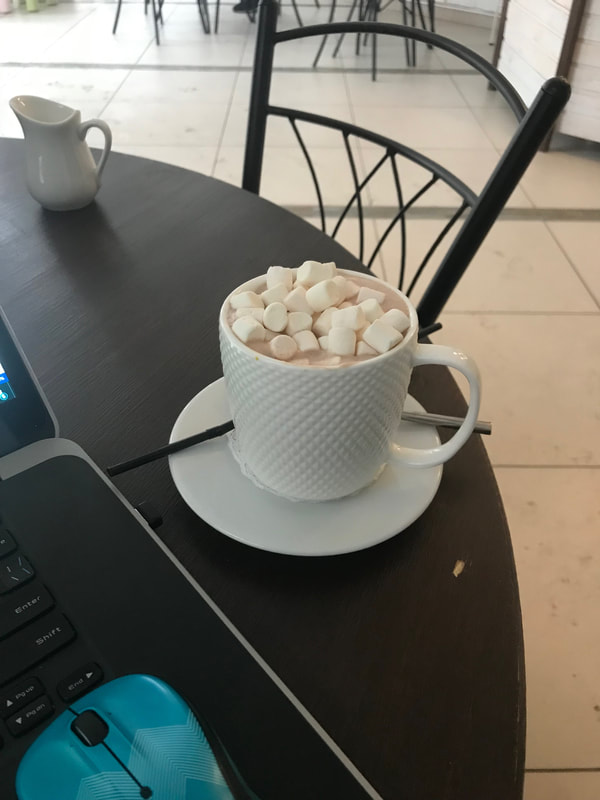 The hot chocolate of champions! Russians pronounce it kakao.  Komsomolsky Prospekt at rush hour (about 6:30pm). Even in the frigid cold, the street is bustling!
Privet! Today I had a great day in the Хохловка (Khokhlova) open-air museum. I had a simple breakfast at the hotel, then worked a bit in the hotel. Olga and Fyedor and his family picked up Cole and I around noon and drove us to the museum, which is located outside of Perm in a small деревня (derevnya, village. This word also means wood!) on the Kama River. I love driving through the country - the plains and snow-covered pine trees are just beautiful. It was also cool talking with Fyedor's dad (in Russian, with some translation help from Fyedor) because he knows so much about the history of the Perm region. As he wisely put it, без прошлего нет будущего (bez proshlovo nyet budushevo, without the past, there is no future). The museum was fantastic. We started by drinking some tea and enjoying snacks in the cafe at the museum. There were beautiful traditional items around the room (like hunting skis, ceramic art, and decorations). One of the decorations was a small смоляной бочок (smoyalnou bochok, bull), which is related to a Russian folk tale. There was also some wonderful Russian folk music playing. While we enjoyed our tea and snacks, Fyedor's family told us a bit about traditional Russian philosophy, which often centers around finding a place to be by yourself and find harmony and peace within yourself. I consider myself more of an introvert, so this really resonated with me! After eating, we got to put on traditional Russian boots, called валенки (valenki). They are made from a single thick piece of wool felt. I was not expecting them to be warm or functional, but they were warmer than my modern winter boots, and stayed perfectly dry even after trudging through the snow for an hour. In the museum, there were old wooden buildings from all over the Perm region, built between the 17th and 20th centuries, and moved to the museum later. The buildings had no metal components (including nails), and were constructed just like Lincoln Logs. I loved looking at the joints used to fasten the buildings together. There was often lichen or grass in between the joints to help keep the buildings insulated. Many of the buildings in the museums were houses or farm buildings. There were a couple of church buildings, a bell tower, a windmill, and some buildings from the salt mines in the Perm region (related to the Salty Ears symbol of Perm). I noticed that several of the buildings had glass windows, which I was not expecting considering the age of the buildings. I learned that in the 16th century, it was uncommon for normal houses to have glass because of the high price of such a commodity. Usually in that time, only churches or administrative buildings could afford class. However, in the 17th century or so, it became more common for people to afford glass windows in their private homes. After the museum, we drove back to Perm and had some food at a столовая (stolovaya, dining hall/cafe) near the school. We had some tasty borscht, chicken, пуре (puree, mashed potatoes) and морс (mors, one of my favorite fruit drinks). After dinner, Fyedor, his dad, and Olga drove us to the Molot stadium to catch a basketball game with Max, Alena, and some of their friends. They had all been Olga's students in high school, and are now studying in university. This was the first basketball game I've gone to, and I enjoyed it. Our team, Parma, was ahead by 14 points at one point, but we ended up losing by 1 or 2 points. The game was also cool because there were several Americans playing on the Parma team. From the size of the audience, basketball seems even more popular than hockey. After the game, we went to a nearby restaurant for a bite to eat, and got to meet one of the basketball players - another one of Olga's previous students! It's really neat to see how connected everyone is in Perm; it's a small world after all. Do Zavtra, Piper Privet! I had a great day. I slept in later than normal, and worked in the hotel for a bit until Maria picked up Cole and I for lunch at the school canteen. We had meat with rice, and tried Russian milk soup. It was very sweet and milky, with noodles in it. It was pretty good, and the taste reminded me of kasha. After lunch, we met with several students from the school. They took us to a cafe near the school where they go to play board games. It was awesome! There were two giant shelves packed floor-to-ceiling with all sorts of boardgames. There were lots of comfy couches and tables, and they served tea, coffee, and cookies. We played a couple rounds of Jenga, a game called Bandit (similar to the game Mafia), and then a dice game called Bluff. It seemed like a pretty popular place for students and families. After the cafe, we walked to a nearby exhibition center for a college/university fair. On our way, we stopped in at a McDonalds so that we could see what it was like. I'm not a huge fan of McDonalds, but I had a McFlurry (in spite of the cold day, almost -20deg C, I can never say no to ice cream!). The McDonalds was much cleaner than ones in America, but the students said they are normally not very clean. The college fair was really cool! It was just like a career fair, except with universities from the Perm region. Most of the students are in their last year of school (11th grade) so they walked around and talked with representatives from schools. There are a couple of престижный (prestizhny, prestigious) universities in Perm, and some students wanted to attend these schools, while others wanted to attend school in Moscow. Most of their university applications are due in the Spring, which is much later than American applications! If the students do not get into university, then they have to serve a mandatory 12 months in the Russian armed forces. Russian school applications are also based mostly off of test scores and a short personal motivation statement. There is one national Russian exam for entrance into university, and unlike the SAT or ACT, it is only offered once a year. Naturally, the students prepare very intensely for this exam and are quite nervous to take it! At the fair, I saw a booth for the aerospace engineering department at a state university in Perm. Of course, I had to go say hi! I was really excited to see that two young women were manning the aerospace engineering table. We had a good conversation (in Russian) about our respective departments, the classes we took, and what we wanted to do after we finished our studies. One of the students wanted to continue studying for a Master's degree, while the other wanted to get a job at a local airplane engine factory called Авиадвигатель (Aviadvigatel, literally translates to airplane engine!). After the university fair, we walked to a shwarma restaurant nearby the school. The students say they like to go there after class sometimes. It was my first time trying shwarma, and I thought it was delicious! After dinner, the students walked us back to the hotel and we said goodbye. Then, Cole and I went to a nearby cafe to listen to a concert played by a local band called Шапито (Shapito) as recommended by Alena (from yesterday). The band was two guys with an acoustic and an electric guitar, and they played some great music! I couldn't quite translate all of it, but I caught a couple phrases here and there. Looking forward to a great day tomorrow! Do Zavtra, Piper What a long and wonderful day! I started my morning with my typical hotel breakfast, then Maria picked up Cole and I for school. I had two lessons today. The first was at about 9:30am, for a 9th grade class. We did my favorite lesson plan with Bernoulli and thermodynamic experiments, and I tied in how an airfoil creates lift by Bernoulli and Newton's Third Law. This was one of the more shy groups! But they were still very bright and engaged in the experiments. Afterwards, one of the more vocal students came up to me to thank me for the lesson. He said that he really appreciated the hands-on experiments, since they don't often conduct experiments in their physics classes. I was so touched, and happy to hear that the lesson was a valuable and memorable learning experience for the students! After the lesson, Cole and I had a long break. We had "second breakfast" in the school canteen (a sort of fried chicken with boiled potatoes). Then we worked in the multi-purpose activity room/teachers' lounge/office hours space that has become our home base. I finished the book I have been reading, called "The Russian Dreambook of Color and Flight," by Gina Oschner. It was a very interesting book, and there was a lot of beautiful symbolism and theme relating to (as the name implies) flight, color, and always making the best of one's situation. I was particularly interested in reading this book because it is set in Perm shortly after the fall of the Soviet Union. While it was a beautiful story, it depicted a very different, more sorrowful and devastated Perm than the Perm I have so enjoyed this January. I am going to keep thinking and pondering the themes and messages of this book throughout the month... My second class was shortly after noon today. It was a different group of 9th graders, and once again we discussed Bernoulli, lift, thermodynamics, and forces of flight. I've gotten very good at giving this lecture! I will be sad to retire the experiments we've done for the rest of the month, because they are wonderful and educational experiments. But next week, the students will be building water bottle rockets! I am excited to see their creative designs. Normally, Cole and I teach at the same time. However, Cole's second class today started just after mine ended. So, we were able to watch each other teach! Cole did a great job of catching the students' interest with a demonstration at the start of his class, and engaged them by having them solve problems together throughout the class period. I even learned something about algorithms! After class, Cole and I had lunch in the canteen. It was a delicious vegetable soup, followed by meatballs (cutlet) with pasta. Then, Cole and I watched the students play a basketball game. Basketball is the most popular sport at our school, and students spend a whole quarter in P.E. learning how to play and practicing! The game we saw today was between 10th and 11th graders, and was in the gym at school. They were all much better at basketball than I am! After the game, Maria took me, Cole, and our student friend Andrei to see a planetarium show! The show was called "звезда. музик. любовь." (zvezda. musika. lubov. stars. music. love.) I expected the show to be about the constellations and the stories behind them, but much to everyone's surprise, the show was more about love stories than stars or music... Maria said we may get to see another show later, that is more about the cosmos! Regardless, I enjoyed seeing the planetarium. There were not very many people there; maybe only 10 folks including ourselves. There were several delightful exhibits with pictures of old Russian planes, and space-themed postcards. The inside of the planetarium dome was lined with the Perm skyline. When the lights in the planetarium went dark, the windows in the buildings lit up! It was beautiful. After the show, we went back to the school for dinner. Then, Cole and I met Max, a former student of our school who now studies social sciences at an international university in the Netherlands. Cole and I went to Max's house for dinner (second dinner!), where we met his lovely family and girlfriend, Alena. Russian families are incredibly hospitable and welcoming, and Russian mothers are incredibly good cooks, and love feeding people! Max's mother endearingly urged us to eat, "Кушайте! Кушайте!" (Kushaite! Kushaite! Eat Eat!) There was so much delicious food, from pelmeni to a traditional meat pie, to бутерброд (buterbroad, an open-face sandwich made of bread, butter, and caviar). We spent the evening in the traditional fashion: sitting around the table, sharing good food and conversation, laughing and enjoying each other's company. Max shared some family photos from an old photo album, and we exchanged good movies to watch (including one about the first cosmonauts that I look forward to watching). We ate, had a short rest, then drank tea, had a short rest, drank more tea, had another rest, then drank even more tea! The family had recently learned an Eastern Russian phrase for resting between drinking tea: чай присадешка (chai presadeshka). I was also very happy to be able to speak with the family in Russian, because Max and Alena were the only two who knew English. In spite of my many grammar mistakes, the family said that I spoke very well, and had great pronunciation! Even Max said that he was confused at first, and thought I was a translator when we first met! I felt very proud :) Being around the language and constantly hearing the sounds and pronunciation has certainly helped. Overall, I had a lovely day, and enjoyed spending the evening with Max and his wonderfully welcoming family! Do Zavtra, Piper Privet! Today was full of learning, both for the students and myself! After a good breakfast at the hotel (bliny, eggs, and coffee), Maria drove Cole and I to school. We each taught two classes today. My first class was the same group of students I had yesterday; plus some whose schedules didn't allow them to attend yesterday. We did one of my favorite experiments that I've dubbed "airfoil spoons." In this experiment, hold a spoon vertically by the handle. Hold it very loosely, so that it can swing back and forth like a pendulum. Then, simply tap the curved back of the spoon lightly against a stream of smoothly flowing water. The spoon should be sucked further into the stream! This is due to Bernoulli's principle. The flowing water on the back of the spoon has lower pressure than the standing air at the front of the spoon. This pressure difference causes the spoon to be sucked into the water. We did some more experiments with Bernoulli (will blowing air between two balloons make the balloons move further apart or closer together? Can you move a ping pong ball out of a cup without touching the ball or the cup?). The students hadn't learned Bernoulli before, and they quickly caught on to the principle. I tied the principle in to how an airfoil produces lift, then I showed them the wind tunnel, and we watched the smoke over the wing of a model Piper Cherokee. I had a short coffee break, then set up for the next class. My second class today was another group of 9th graders. I only have this group for one lesson per week, so we had to fit more into the class period. We started with the Bernoulli experiments, then conducted another experiment with thermodynamics. We also did the soap-powered boat experiment, and played around with the wind tunnel. Throughout the lesson, I made sure to tie in the experiments with how airplanes fly and produce lift. I think my lessons get better the more I practice them! I have also been speaking a very small bit of Russian in class, mostly just phrases like "good," "let's continue," and "do you understand?" I am nervous speaking Russian in front of the students, just as they are nervous speaking English to me! But, I asked them to please correct me (исправлять меня, ispravlyat menya) if I make a mistake (сделать ошибку, sdelat oshibky). Immediately after class, Cole and I had lunch in the school canteen. There was a delicious potato and vegetable soup, salad with chicken and mushrooms, and then rice with grilled chicken. We then met with Iulia and Slava, and went to observe a 3D modelling lesson at an academic center nearby the school. The center is a place where students at our school can go to learn about technical things as an extracurricular activity. Iulia told us that they call it the муравейник (muraveinik, anthill), because of all the students bustling about like ants! The center was very beautiful on the inside, with tall ceilings, large windows, and great classroom spaces. In the classroom where the students were CADing, there was a plethora of awesome MakerBot 3D printers! (which are also just called 3D printers in Russian.) There was also a лазерная станок (lazernaya stanok, lazer cutter), and a router. It was quite the capable maker space! Students from all ages, even as young as 6, are able to take lessons here and learn how to CAD and 3D print things. The students in the class we observed were 10th graders, and they were preparing for a конкурс or соревнование (konkurse or sorevnovaniy, competition) for 3D modelling. They're judged based on how functional and creative (креативный, kreativniy) their design is. At the center, I learned that maker spaces are just starting out in the city, but they are quickly gaining popularity. Outside of the center, there is only one maker space in Perm right now. Robotics and 3D printing are also quickly gaining popularity in the city, and many university students participate in "battle bot" competitions. After visiting the center, Iulia and Slava took Cole and I to see PermM, the Perm Museum of Modern Art. They said that the museum used to be in a much larger building, and had a lot of funding and popularity until the large economic downturn in 2012. Now, the museum is in a much smaller building, but makes great use of the space. I did notice that it seemed to be less popular than other museums and attractions we've visited, and there seemed to be a lot of skepticism towards modern art. There was a very small fee to pay (about $2) to get into the museum, which is typical of museums and attractions in the city. The theme of the exhibit was "На Маяк. Форма и Политика Света" (Na Mayak. Forma y Politika Sveta, To the Beacon, the form and politics of light). As the name of the exhibit implies, many of the artworks toyed with the notion of light, darkness, and their intersections with politics and dystopia. This was represented even in the layout of the museum. Much of the museum was very dimly lit, and the rooms that housed the exhibits were very plain and simple. I'm not sure if this was to stay in budget, or to direct attention to the art instead of the building itself. It was a very interesting exhibit! I thought one of the most interesting artworks was a series of digitally edited photographs of Lenin's tomb (where you can still to this day see the preserved body of Lenin, in the Red Square in Moscow). In each photo, there was an LED sign over Lenin's tomb with a different phrase. In the middle of the floor, there was a wooden model of Lenin's tomb, painted red and surrounded by statues and busts of Lenin. I got the impression that it was a bit provocative as a piece of art. There seems to be several main differences in opinion about Lenin in Russia right now. Some people, usually in the older generation, believe that Lenin's work in the government was a wonderful and necessary thing. Other people believe that Lenin is over-idolized, and that Russia needs to move on from celebrating him so profoundly. One of my favorite artworks was a series of multimedia sculptures in the stairways of the museum. They struck me as genuine, heartfelt, and elegantly simple. They also had short hand-written descriptions next to them (in Russian) that I was able to read by myself! I liked reading Russian in the artist's hand writing, rather than typed print. We explored all three floors of the museum. On our way out, I noticed that the museum had a very small souvenir shop (more like a small kiosk) that is typical of other museums I've seen here. We also found fun brochures that explain some context of the exhibits, and give some tasks for museum-goers to complete to help them cultivate their thoughts on the artwork. It's too bad we didn't see them at the start of our trip! After the museum, we rode a trolley bus back to Komsomolskiy Prospekt (the main street in the center of the city, where our school is, and just a couple of blocks from our hotel). On the way, we passed by ЦУМ (Центральный УниверМаг, Sentralniy UniverMag, the main shopping center in the city). On Komsomolskiy, we saw a statue of the famous mascot of Perm, the bear! It's good luck to rub his nose, so we each made a wish. Then we saw a sculpture of Salty Ears, the same legend as the troll/gnome that we saw near the Kama River the other day. We then went back to school, and Cole and I had a quick dinner in the canteen. It was noodles and fried chicken cutlet, with a slice of the best, fluffiest bread I've ever tasted. Then, we dashed upstairs to accompany Iulia in one of her lessons. Iulia tutors English at the school, so the 5th graders in the lesson practiced asking us questions in English. They were so energetic and curious, and asked great questions! It was fun talking with them. Afterwards, a lot of them asked to take pictures with us and gave us hugs. It was adorable! On the way to the hotel, Masha told us a bit about the structure of the grades and classes here. There's a very different vocabulary than in America. First of all, students in school (1st - 11th grade) refer to their grade as their class. So, instead of being in the 2nd grade, they say that they are in the 2nd class. Secondly, at this school in particular, each class is divided into 3 or 4 different groups or courses. The groups correspond to different levels of academic rigor, and the highest group is called the олимпиад (olympiad) group. I had a great day. I feel successful in teaching the students today about how airfoils produce lift through Bernoulli and Newton's Laws, and I'm excited that they all seem engaged and happy in lessons. I also really enjoyed visiting PermM. I think it was a great place to learn about different attitudes that exist in Russia, and experience the contemporary art of another interesting culture. Do Zavtra, Piper Privet! I had a wonderful day today. I had a tasty breakfast in the hotel of оладки (oladky, thick tasty pancakes) and eggs with some juice. Masha picked up Cole and I a bit earlier this morning so we had more time to prepare for our morning lessons. I've been keeping most of my supplies at school, so I had plenty of time to set up just the supplies I needed in my classroom. I had another group of students today (grade 9D) and they were great students. There were only about 15 or so of them in the class, which was a nice amount of students to teach. Today, we explored the four forces of flight. The students hadn't heard of the four forces of flight before, so I was excited to teach them something new today! To learn about lift, the students built "helicopters" out of some paper and a straw. The students learned that a larger rotor generally leads to more lift, but you must make sure that the larger rotor does not weigh more than the lift it produces! Some students also were very clever and twisted the rotors to create a more fan-like shape, or used a longer straw to help stabilize their helicopter. Then, the students built "aerodynamic decelerators" (i.e. parachutes) to learn about drag. As the students were finishing their parachutes, I walked around with a fun demo about volume and matter. Try it yourself at home! Take an empty plastic soda bottle, hold it horizontal, and rest a small ball of paper just inside the mouth of the bottle. Now try to blow the paper ball into the bottle. It should fall out of the bottle, rather than going into the bottle! This is because the volume of the bottle is already occupied by air, which we often forget has mass and volume, just like all matter. To blow the paper ball into the bottle, you first need to cut a hole in the bottom of the bottle. This allows air to escape when blowing into the bottle, and now the paper ball will fly into the bottle! Time moved very quickly this lesson, so I may need to adjust future lesson plans to reflect this. This lesson, I had also prepared models of the different activities (helicopter and parachute). Even if the models were not very complicated or did not work perfectly, I saw that it was useful for the students to have a starting point, and make sure they understood the goal of the activity. The students were all engaged with the activities and seemed excited to learn. I left the class feeling successful! After class, Masha took Cole and I for a walk in the neighborhood. We first stopped in a souvenir shop that was full to the brim of traditional and handmade Permian memorabilia. Then, we went to Gorky Park and rode the Ferris Wheel. It was an enclosed and heated gondola, otherwise it would have been freezing! It was a beautiful day too - the sky was fairly clear and we could see the whole center of the city. We only got to ride around the full circle once, though. We went back to school for lunch - borscht (mixed with sour cream, as is traditional), fried fish, and rice. Then we had some free time in the afternoon. Maria drove Cole back to the hotel, and I stayed at the school to work while Maria taught a couple of lessons. I needed to resolve my wind tunnel, build an airfoil with tell-tales, and test out a couple of other activities. (I learned from the first day of teaching that I should practice the remaining activities I had planned to make sure they all worked. A good thing I did - one activity worked great, while the other was a flop.) I am also so excited to be able to see the smoke in my wind tunnel now! Я починила его (Ya pochinila yevo, I fixed it)! I simply had to rearrange the order of the components. Before, I had the fan at the front, blowing air into the tunnel, then the incense stick (for smoke) inside the tunnel. However, the fan is so strong that it just extinguished the incense stick. By rearranging things so that the fan is at the back, sucking air through the tunnel, and the incense stick is at the front of the wind tunnel, I mitigated the problem. It also helped that I lined the inside of the tunnel with black paper and shone a flashlight through the clear ceiling of the tunnel. I can't wait to share the new and improved tunnel with the students :) I had a cup of tea with Masha to celebrate my victory, then Masha drove me back to the hotel with dinner to-go from the school canteen. I had a little while to rest, read, and eat dinner (chicken, potatoes, and a creme-brulee pie). Then, Cole and I met a student named Alicia at the hotel. Alicia is one of the students whom we helped with pronunciation while singing. She is a great singer, and loves music and theater, so she accompanied us to the opera house for a symphony orchestra concert. The opera house was absolutely beautiful! It was smaller than the Boston Symphony Orchestra, and had a beautiful ceiling painted with Greek mythology and a grand chandelier that reminded me of the Phantom of the Opera. The opera house also had some cool exhibits with props and sets from previous ballets or operas performed there. It seemed very popular - it was a full house on a Wednesday night! The music was absolutely splendid. The orchestra played several pieces by Mozart, Back, and others, including several arias and opera pieces. The guest soprano had a gorgeous voice and really got into the music. Overall, it was a lovely day thanks to airplanes, music, and good company! Do Zavtra, Piper Privet! Today was our first day of teaching! I had breakfast in the hotel (bliny, an egg, and coffee), then Maria took me and Cole to school around 9:45. We dove right in to setting up for our first lessons. Today, I taught a class of 15 to 20 11th graders. I spread several experiments and activities around the room, then started off class by introducing myself and explaining aerospace engineering. I described that this workshop would be very hands-on and interactive, and will help the students develop an intuition for concepts important in aerospace engineering. I then walked the students through the setup of each experiment, then had them stand up and move around the room doing experiments that interested them. At the end of the class, we went through all of the experiments again, discussing what the students observed, and how this tied into aerospace concepts. I was a bit disappointed because some of my experiments did not work. The sand pendulum to teach simple harmonic motion did not work - I tried using salt rather than sand due to availability, but the salt is very "sticky," and did not dispense out of the pendulum like I wanted. I had also tried designing a tool to teach about thermodynamics (a u-shaped piece of tubing with water in the bottom of the u. By changing the parameters/variables on one side of the u, you can see how the pressure and volume of the other side changes based on the water level). But alas, this tool did not work very well either. This is because the hair dryer used to change the temperature parameter does not heat up the gas in the tool enough to cause a noticeable pressure change. I was excited to set up and use the wind tunnel, however, it was hard to see the smoke inside of the tunnel. I will try to get it working by lighting the inside of the tunnel differently. If that does not work, I can have the students use "tell tales" instead of smoke to observe airflow. Tell tales are small pieces of string taped along the surface of the wing. They allow engineers to see where the airflow over the wing is attached or separated from the airfoil. In spite of the unexpected challenges, I had plenty of material to easily fill the class period with meaning activities. We even went a bit over time! I was excited because the students had never learned Bernoulli's Principle before, and the experiments we conducted really seemed to help them understand the concept. Overall, I had a much easier time teaching this class than in Kazakhstan. (in no particular order) First, I am much more experienced as a teacher, having done GTL last year. Next, I think the shorter class periods are easier to lead than longer class periods. Finally, rather than using a powerpoint presentation and lecturing for long periods of time like I did last year, I had the students stand up and move around, and engage with the experiments themselves. I also noticed that the experiments and activities I had already tried or conducted in the past went much more smoothly than the experiments I hadn't had the chance to conduct before class! This is a great lesson in how to prepare for future workshops: always test out your activities. After teaching, we met Masha (a nickname for Maria) and went to lunch at school. There was a delicious soup with onions, meat, and some sort of grain, steak and potatoes, and a salad with chicken, red pepper, and green beans. After lunch, two students named Emill and Bogdan took Cole and I to a fitness center/swimming pool in the city. It was both similar and different than an American pool. The first big difference is that, before you are allowed into the center, a nurse checks the bottoms of your feet, hands, arms, and belly to make sure you do not have any rashes. The other large difference is that you are required to wear a swim cap in the pool. The center was very modern. They even had these rubber bracelets that looked like a small watch. Instead of the watch face, there was an RFID chip inside that you could use to get in and out of the pool area, and lock your things in a locker. The pool was very popular; there were lots of people of all ages. There were several pools in the center; one for children, a large 50m pool for swimming laps, and a smaller pool with a 10m diving well (no diving boards though), and a section with jacuzzis and a small lazy river. This smaller pool reminded me of the Freedom Center back home in Northern Virginia. We enjoyed some time in the lazy river and diving well, then tried a Turkish and a normal sauna. I have never been in a sauna before! I'm glad I tried it, but it was not my favorite experience. It was too hot for me! There was also a traditional Russian обливная кадушка (oblivnaya kadyshka) - you basically pour a bucket of frigid water over your head! After the pool, we had a cup of tea in the cafe upstairs, then went to see a couple sights around the city. We saw a memorial for the 250th anniversary of Perm (that also functions as a sundial), a WWII memorial, and a theater called "theater theater." We went to Perm #2, a popular train station in the city, then rode a trolleybus back to the school. We had a tasty dinner of spaghetti with beef and for dessert, a small cake with the best whipped cream I've ever had in my life. Andrei met us at the school, and took us around Perm for a walk after dinner. We walked through Gorky Park, down to the River Kama, then back to the Ice Town we visited a couple of days ago. It was so beautiful lit up in the evening! We stopped in a local bookstore, and I had a great time testing out my reading level with different books. I had a great day teaching today, and I am excited to apply my lessons learned tomorrow! Do Zavtra, Piper Privet! Today was probably the calmest (самый спокойкий, samy spakoiny) day we've had this trip. I had breakfast at the hotel this morning: my usual bowl of kasha, with a sort of potato-and-cheese pancake that reminds me of a latke. I enjoyed watching the Russian morning news while I ate! Maria picked up Cole and I shortly thereafter, and we went to our school. We spent the morning preparing for our classes tomorrow. Maria gave us our final class schedule, and I had to rearrange my lesson plans a bit. I will be teaching one or two classes per day (depending on the day) to 9th and 11th graders. I will only have 45 minutes per class, so I needed to prioritize which activities and experiments I want to share with the students. It was tough rearranging the lesson plans, but I'm happy with the end result. We had lunch at the school: cabbage soup, шашлык с курицей (shashlick suh kuritzey, chicken kebab), and a warm cup of tea. Then, Cole and I listened to some students rehearse a performance. They are flying to a competition in March where they will sing a couple of popular American songs from the 50s. The students will be judged both on musical ability and English proficiency, so Cole and I helped them check their pronunciation. They sounded great, and I'm sure they will do quite well come March! In the afternoon we did a bit of shopping. I needed some supplies for class (finally wrapping up the last of my purchases...). Maria drove us out of the center of the city to a sporting goods store. The supplies were much cheaper there, since we are staying in the very center of the city! I picked up a bike pump for water bottle rockets, as well as a swimsuit. (don't worry, I'm not joining the polar bear club! We are going to the pool tomorrow.) In the car, we listened to some great Russian pop music that I added to my playlist. I also learned some fun idioms and phrases in Russian, like "Где? Где? В Караганде!" (Gdye? Gdye? V Karagandye!) It's like a joke - because it rhymes, and because Karaganda is a far away city in Kazakhstan. There's a similar idiom that goes "кудыкина гора" (kudinkina gora). The first word, kudinkina, does not have a direct translation to English. Gora means mountain. The gist of the idiom is also that something is very far away, past the mountain. While we drove, Maria also pointed out that buses and public transportation vehicles (like trolleys) have their own special lane (the rightmost lane) to help mitigate traffic in the city. We drove back to the school for dinner, and enjoyed beef with quinoa and a bread pastry filled with творог (tvorog, Russian cottage cheese). Then Maria took us back to our hotel. I spent the evening putting final touches on my workshop and packing supplies for class tomorrow. I have my bookbag, a small suitcase, and a shoulder bag full of things for class! I'm a bit nervous, but overall I'm excited to meet the students and share my love of aerospace with them. Do zavtra, Piper P.S. One fun tidbit that I forgot to share yesterday! Iulia told Cole and I about the special holiday on September 1st in Russia. Every school in Russia starts on September 1st after summer vacation, and there is always a big celebration! The students gather in an assembly, and 11th graders (last year of school) file in holding the hand of a new first grader (first year of school). An 11th grade boy will then carry a first grade girl around the auditorium on his shoulders, as she rings a bell symbolizing the start of the school year and ringing in the new class of students. 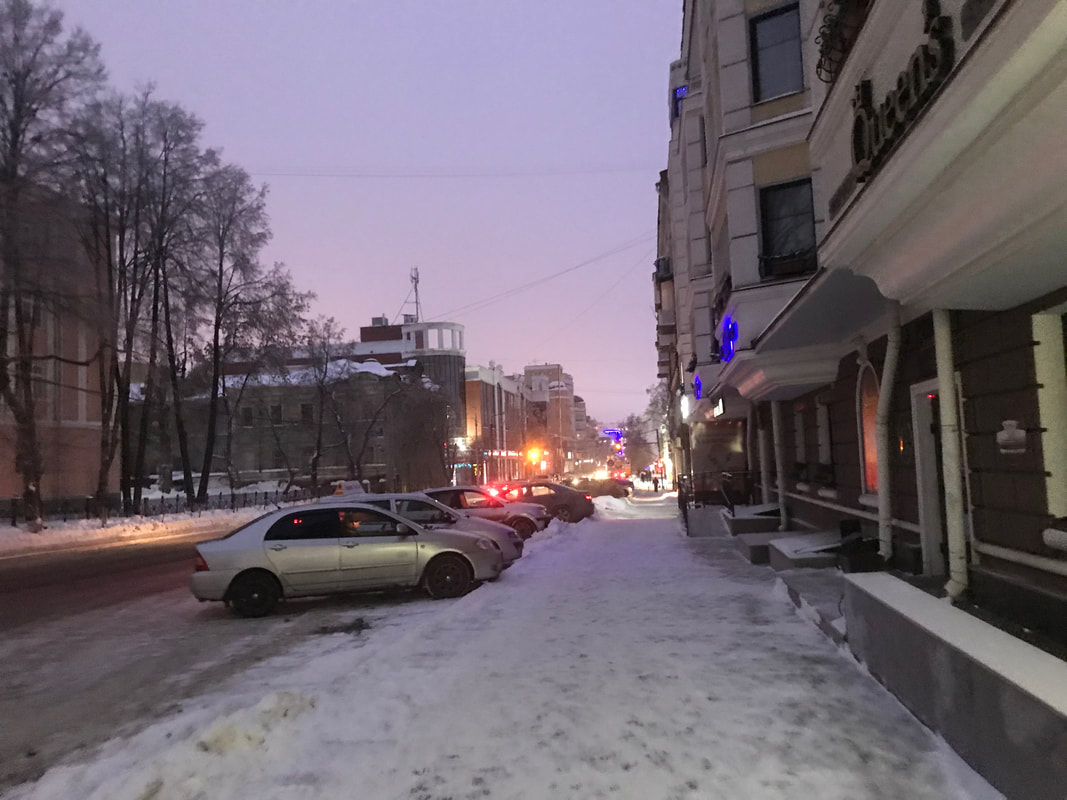 Guess what time I took this picture? After breakfast at the hotel, at 9:30 in the morning! The sun doesn't rise until 10:00 or so here. Privet! Today was full of art and culture. I started the day off with breakfast in the hotel: pancakes with black currant jam, a hard boiled egg, and a clementine. While I think the breakfast at school has better food, I still enjoy eating at the hotel because they play lots of popular Russian pop music. I have a great playlist of Russian music that I am always looking to expand! After breakfast, I went shopping for some class supplies. Like in Kazakhstan, it is very challenging to find Ziploc bags here... At about 12:30, Cole and I met with Iulia, an English tutor at our school. She took us to lunch at Сковородка (skov-oh-ROAD-ka, frying pan), a cafe that made all sorts of блыны (BLEEN-ee, thin Russian pancakes like crepes). I had блыны stuffed with chicken and kidney beans, served with a garlic sauce that reminded me of tzatziki sauce. Next, Iulia took us to visit the Perm State Art Gallery (Пермская Государственная Художественная Галерея, Permskaya gos-oo-DARST-ven-aya who-DO-zhest-ven-aya gall-er-EH-ya). The gallery was built inside of the Spaso-Preobrazhenskovo monastery. The monastery was initially built in the 1400s, and was converted to a gallery in 1922 after undergoing restorations. The gallery features Russian art mainly from the 19th and 20th centuries, as well as some Italian paintings. The placards describing the pieces listed the artist's name, title of the piece, and year in Russian, and gave the artist's name in English as well. I was surprised that most placards did not say what medium the art was created with. There were also several (but not many) larger descriptions of artists and eras, but only in Russian. The main attraction of the gallery was its religious paintings and wooden sculptures. There was an entire room dedicated to religious paintings (on wood) from the 17th century. Some of the paintings had Russian writing that not even Iulia could read! This room was beautiful, with a metal-tiled floor and soft choir music playing in the background. The placards for each painting in this room including not just the artist name, title, and approximate year, but a short blurb describing the piece. At the back of the gallery was a huge fresco that is seen in most traditional Russian churches. It stands as tall as the ceiling of the church (three stories in this case), and is wood painted with elaborate religious scenes and stories in vibrant colors. You could see parts of the fresco from every floor of the gallery. The third floor of the gallery was open to the top of the spire, and full of wooden sculptures and religious icons gathered from around the Perm region. As with the other room of religious paintings, each of these beautiful and intricate carvings had a short description in Russian about its meaning and origin. It was clear from the layout and attention paid to these exhibits that the museum and the city take pride in their beautiful religious artifacts. I enjoyed visiting the gallery, seeing the Russian artwork, and admiring the church itself. I found it interesting that the gallery relied on natural lighting from the windows of the church (because in most American galleries I have been to, the exhibits are often lit with artificial light). I am curious if the natural light in the gallery will have any effect on the artwork there. I also noticed that the frames for the paintings were ornate and beautiful (just like in American galleries), however, they looked very old as they were cracked in many places. It was also interesting that more people seemed to be at the gallery than at the regional museum we visited with Maria and Andrei. Next, Cole, Iulia, and I went next door to a smaller contemporary art gallery with paintings from local Perm artists. Here, our school was putting on an event where the students recited poetry and stories, and played music. Most of the pieces were by a Russian author named Konstantin Paustovsky. While the stories (сказки, SKAZ-ki) and poems (стихи, STEE-hee) were in Russian and I wasn't able to understand all of them, I loved hearing the cadence and rhythm of the language. Even though I couldn't pick out individual words, I could still hear the rhyme scheme of the poems. Cole and I met several students afterwards. They were very shy, and seemed surprised when I greeted them in Russian! After the event, Iulia, Cole, and I met with Iulia's friend Slava, and we walked along the Kama River. Slava pointed out that the peaceful bird song that I heard a few days ago was actually fake - it was played over speakers along the river! We saw a statue of a house gnome with large ears, holding a bag of salt. The bag of salt said, "May salt come to your home!" which is a well-wishing phrase in Perm. The large ears are also a symbol of Perm: Perm used to be a salt mine, and when salt fell on the ears of the miners, their ears would swell. We also saw a large sign that says "Счастье не за горами" (SHAST-ye ne za GOR-ahmy) which means "Happiness is not behind the mountains." It is a поговорка (poe-go-VOR-ka, proverb) that means that happiness is here in front of you! Iulia and Slava told us that the area around the river was recently remodelled with new lights and stairs, but that many people are disappointed with the renovation because it was very expensive and did not look as beautiful as expected. We then took a bus to Gorky Park, which is right across from our school. The park is full of attractions, slides, rides, roller coasters (which Russians refer to as "American roads") and food stands. The park is very popular with families and children, even in the cold winter when many of the rides aren't in operation. We walked all the way across the park, then went to a nearby mall to eat at the foodcourt. We had potatoes with mushrooms, and hot tea to warm up from our walk. Cole and I were taken aback because we simply left our tray and dishes on the table in the foodcourt to be cleaned up by an attendant! There was a sort of arcade in the mall, and we played several rounds of air hockey. I didn't win any matches, but did alright! We walked back along Sovetsky street to our hotel. Along the way, we saw a statue of Pushkin with 2D bronze sculptures depicting some of his famous stories. We also saw a red line painted on the sidewalk. There are several of these paths around the city, and they take you on a walking tour of famous sites. Each tour is themed around a love story. The red line we saw tells the story of the writer Dmitry Mamin-Sibiryak and his wife Maria Geinrikh-Rottony. One thing I've noticed while walking in Perm is that most pedestrians follow traffic rules strictly. You rarely see jay-walkers because you could be fined 250 rubles (about $4). If you don't pay the fine in 2 weeks, the fine doubles. Tomorrow marks one week in Russia, and I am excited to see what adventures the next week brings! Vsevo Dobrovo, (Best Wishes) Piper Happy Old New Year! In Russia, there are two calendars: the Julian calendar and the Gregorian calendar. The Gregorian calendar was not adopted until 1918. Thus, nowadays in Russia, many people celebrate New Year's twice: once according to the newer Gregorian calendar, and a second time according to the older Julian calendar (hence the name, Old New Year, or старый новый год, starry NOV-y goad). Russian people also sometimes celebrate two Christmases (one per calendar), and they often celebrate Крещения (cree-SHEN-ee-yah, Russian Orthodox Christening holiday on January 19th). During Крещения, people cut large holes in the ice on rivers and lakes, and bath in the frigid water! I saw something similar in Astana last year. Cole and I spent this Old New Year with a seventh grade student from our school named Fyodor and his parents. What a busy and wonderful day! We started off with breakfast at the hotel (kasha, a clementine, and some coffee), then Fyodor's family picked us up from the hotel at about 10:30 to drive to Kungur. Kungur is a small city about 1.5 - 2 hours south of Perm. Our first stop was at the Белая Гора Монастырь (BELL-ah-yah GORE-ah mona-STEER, White Mountain Monastery). The monastery was so named because it sat atop a mountain and, in the wintertime, everything was covered in a layer of bright white snow. As Fyodor said, if Anna did not stop Elsa from freezing everything, you would end up with Russia! The view was beautiful - Fyodor's father told us that you could see for 20km! The monastery itself was also beautiful. It is currently in operation as a monastery, but is still a very popular place for both international and Russian tourists. During the Soviet Union, the monastery was only walls - it had no floors or ceiling. But it recently underwent a 15-year restoration, and the hard work shows! After walking around the inside and outside of the monastery for as long as we could stand (it was -20 degrees C or colder today, and the wind on the mountain was brutal!), we went inside a nearby cafe on top of the mountain for lunch. We had cutlets (like meatballs) with rice and small pieces of crunchy bread shaped in a ring, called сушка (SUE-shka). Of course, we all warmed up with a cup of hot tea as well! Next, we drove to another famous site in Kungur: the ice caves! Our excursion into the caves lasted about 1 hour and 20 minutes, and we travelled 1.5 km under a mountain. The ice caves are located in the Urals on the Sylva River. The caves were first discovered in the early 1700s, and have been a popular site since the early 1900s. They were widely explored by Alexander Khlebnikov, who went on exploratory excursions in the cave even after he went blind at an old age. The caves are so cold from the climate that they are full of ice blocks and frost formations on the ceiling, hence their name. It reminded me of Luray Caverns, except many of the rock formations were replaced by ice! Our guide only spoke Russian, so Fyodor translated for me and Cole. There were several legends and stories connected with the caves, but the most well known is the story of the Tears of the Princess staircase. As the story goes, a woman on an excursion in the cave fell and cut herself, then went on to marry a Swedish prince and become a princess. The staircase she slipped on is called Слезы Принцесса (SLEZ-ah prin-SESS-ah, Tears of the Princess) to commemorate her story. One of my favorite sites in the caves were the underground lakes. They were anywhere from 1 meter to 4 meters deep, and the water temperature was 5 degrees C. The lakes were not frozen like other parts of the cave because they are connected with the Sylva river, and the water level in the lakes rises and falls with the water level in the river. There is also a species of small blind crabs that only exists in the lakes in the Kungur ice caves. After the ice caves, we drove to take a master class on baking пряник (PRIYAH-nik), traditional Russian gingerbread. The masterclass was taught by a wonderful lady named Galina, who welcomed us into her home to teach the class. Galina spoke mostly Russian, and a few vocabulary words in English, and she was pleasantly surprised to learn that I speak Russian! She said that I spoke very well, and that made me feel proud. Galina taught us that gingerbread is only made in certain regions in Russia, and that each region has its own special recipe and style for making gingerbread. To make Kungur gingerbread, you mix honey, butter, water, spices (ginger, turmeric, pepper) and flour to make dough. By leaving eggs out of the recipe, the gingerbread lasts longer. Next, you use a rag to wipe a layer of olive oil on the inside of a wooden mold. Then, form the dough into a hotdog shape, and press it into the mold. The mold is cut about 2 centimeters deep into a wooden panel, so you then use the heel of your hand to form the dough into a bowl in the cut out of the mold. Fill the bowl with a bit of jam (we used apple-currant jam, handmade by Galina). Then roll a piece of dough flat, place it on top of the jam, and use your thumb to simultaneously pinch off the extra dough while sealing the edges shut. Carefully peel the unbaked bread out of the mold, and pop it in the oven on a cookie sheet! Viola! We used wooden molds that were all hand-carved by Galina and her family in traditional Permsky styles. They were so intricate and beautiful, and each mold had a symbolic meaning. I made gingerbread in the shape of лебедь (LEH-bit, swan), ёжик (YOZH-ik, a little hedgehog), and собака (so-BAH-kah, dog). The swan symbolizes love, the hedgehog symbolizes cunning and intelligence, and the dog symbolizes true friendship and loyalty. Russian culture tends to follow more traditional gender roles, and this was especially evident in how some of the symbols were described. For example, the swan was described as a "woman's symbol," whereas a fish had two different meanings for men (luck) or women (bearing children). While we waited for the gingerbread to cook, Galina showed us pictures of her family and some family heirlooms, including a beautiful 15-piece matryoshka doll set. Soon the whole first floor of the house smelled like gingerbread, and we each enjoyed a piece of our handiwork with some tea. The tea was "Ivan tea," which was traded from China to Russia on a trail that passed through Kungur. We all sat around the table, and we took turns opening small Christmas ornaments from a mini-Christmas tree that Galina had set on the table. Inside each ornament was a task to complete; if you completed the task, you got a small prize! I had to sing a Christmas song, and won a matryoshka doll magnet. Fyodor's mother had to guess a Russian song. So, Galina's son played карабушка (kara-BUSH-kah, a Russian folk song typically recognized by Americans as the Tetris theme song) on the accordion. We all sat around the table, singing, clapping, and drinking tea. It was so much fun, it felt like a scene out of a classic Russian film! When we said goodbye, we signed Galina's guestbook. She was tickled pink that I left a message in both English and Russian, including Russian well-wishes for the New Year. We drove back up to Perm and had dinner at a delightful Georgian cafe near our apartment. Fyodor's mother presented me and Cole with a small gift: a beautiful sculpture of снегирь (SNEG-ear, a small bird that visits Russia in the winter) made from a special variety of selenite stone that can only be found in Kungur. I was so touched by her gift! Everyone here is incredibly kind, welcoming, and hospitable, going out of their way to make our stay in Perm comfortable and amazing! Overall, I had a beautiful day and I learned so much about Russian culture by visiting the Belaya Gora monastery, Kungur ice caves, and gingerbread master class in the home of a true Russian artist! Do Zavtra, Piper Privet! Today was busy and fun, but freezing cold! It was -25 degrees Celsius outside (about -13 degrees F) in the middle of the day. Maria drove me and Cole to school for breakfast at about 8:30am. We had kasha and bread with cheese. Then, Cole and I gave a talk to three groups of students about MIT - what it's like, opportunities and faculties, how to apply, and other important information. The students were a bit shy, but they all asked great questions. We were excited to meet one student who has applied early action to MIT! We had tea with her and Maria in between two of our talks, and she is a very smart and motivated young lady. We went to lunch after our talks and enjoyed fried chicken with mashed potatoes and cabbage. There was also a very tasty soup made from vegetables and pureed potatoes. Then Maria and two students (Roma and Andrei) took me and Cole shopping at a "hypermarket" (гипермаркет, GEEper-market). I bought some supplies for my class, and some things for myself (like cookies for snacking, naturally). I was pleasantly surprised at both the selection of items and how affordable everything was in the store. The cashier heard me throw a couple Russian phrases into my English conversation with one of the students, and asked me (in Russian) what I knew in Russian, so we had a short conversation. We next drove to an open-air military museum where there were old tanks, rocket launchers, and vehicles from the WWII era (known at the Great Patriotic War in Russia). Then, Maria and Andrei took us to Пермский Краевой Музей in Дом Мешкова (permsky kra-YEV-oi moo-zey in dome mesh-KOV-ah, Perm Regional Museum in Meshkova's House). Meshkova was a famous businessman in Perm. His home was built in 1886 by the architect A. B. Turchevich. The architecture was indeed beautiful! The museum was three stories, and included exhibits from ancient times until today. The exhibits were all very interesting and well put-together. While each room of the museum was different, the curators tied together the rooms into a story with the use of decorative "themes." For instance, in each room, a set of pretty plaster seagulls hung from the ceiling. The exhibits also often including multi-media aspects. For example, one exhibit was a stained glass window and cabinet from an old Russian home. The museum added in plaster to model the rest of the home, and hung a picture of a church behind the window so that you felt like you were actually looking out on a Russian city. In another room showcasing artefacts from the October Revolution, there were stations to listen to anecdotes and facts (in Russian) at different stations with headsets. The recording spoke at a pace that I could follow, but I did not have enough vocabulary to comprehend the full recording. I also wasn't able to translate all of the signs and descriptions in the museum, but Maria and Andrei helped and provided context for a lot of the artifacts for us. The exhibits appeared to be very neutral; as in, they were presented as descriptions of artifacts, without much bias. Many of the labels for the artefacts were just labels of the name and year; I wish they had included more information about the context of the artefact. Each room of the museum addressed a different moment in history. As a foreigner unfamiliar with the details of Russian history, I think it would have been helpful to have a small description of each period at the entrance to the room. Overall, the museum was very similar to an American museum. One main similarity that I noticed was that the museum was interactive and told a story as you walked through the exhibits. It felt almost like an art gallery to me in that the building itself was part of the historical exhibits. A major difference I noticed was that there was no large gift shop for the museum! The space focused solely on the exhibits. My favorite exhibit was a huge radial aircraft engine, with model aircraft hanging from the ceiling. The engine stood about 4 or 5 feet tall, and was in great condition! I also found the post-soviet era exhibit interesting. It featured a mock-up of a period kitchen with a Russian family sitting down at the table. (fun fact: a copy of The Master and Margarita was on the table!) Around the walls of the exhibit leading up to the diorama were pictures and photos with short descriptions. One picture that caught my eye was a picture of Perm-35, a gulag (prison for political dissidents during the Soviet era). There was only a sentence or two describing the gulag, and no mention at all of Perm-36 (a second gulag near the city). The museum curator said that both gulags-turned-museums have been closed for a while. As I read in several articles about Perm-36, the museums are closed due to controversies about how the museum displayed its exhibits from certain perspectives. All in all, I thought the museum was very informative both about Russian history, and how Russians are proud of their history and display it through well thought-out museums with interesting and interactive exhibits. After the museum, we returned to the school for a dinner of Russian spaghetti and meatballs. Then, we went to see a local hockey game. Perm's professional team are the Hammers (Молот, MOW-lot), and today they were playing against a team from Karaganda, Kazakhstan! (The national bird of Kazakhstan is the Golden Eagle, and I noticed that the Kazakhstani players' jerseys had eagle wings on the sleeves.) It was a close and exciting match, but Perm won 4-3. I learned how to cheer on the players with phrases like вперёд and давай (vper-YOD and da-VIE). We rode a tram (marshrut) back to the hotel. It was slower than a car but faster than walking, but I was glad to be travelling in the warmth and not on foot in the cold! Tomorrow we have another exciting day: one of the student's families will be taking us to see the Kungar Ice Caves, and a masterclass for baking Russian Gingerbread! Do Zavtra, Piper Привет из Перми! Privet iz Permy! Hi from Perm! Today, Cole and I visited our school for the first time. It is named after Alexander Pushkin, the famous Russian writer and poet. It is a beautiful building, with columns out front and large windows on each of the four floors. The school teaches children from grades 1 through 11 (the final grade in Russia), and focuses on technology subjects. The school is also an IB school! Cole and I had breakfast at the school canteen (Russian crepes called bliny and eggs), then had a tour of the school. Our tour was led by two seventh grade students, who were a bit shy but spoke English well and gave an excellent tour! Then, Cole and I sat in on several physics and IT lectures for 10th and 11th graders. We were accompanied by a couple of 11th grade students who helped us translate vocabulary and shared with us about their life and school. I was very happy to have my little notebook today, because I took copious notes on new words I was learning and things I noticed about my surroundings that struck me as unique or different from the United States. For example, students address their teachers by their first name and patronymic (based on father's name), rather than "Mr." or "Ms." Also, physics and mathematics are taught with Latin characters (not Cyrillic) just like in America. In the lectures, the teachers taught формула идеального газа (FORM-oo-lah id-ee-AL-nigh-ah GAUZE-ah, the Ideal Gas Law) and сило трения (SEE-lah TREN-ee-yah, friction force). I also learned a Russian pneumonic device for remembering the colors in the visible spectrum: Каждый Охотник Желает Знать, Где Сидит Фазан (KAZH-dee ah-HOT-nik zhe-LIE-yet znat gde sea-DEET fa-ZAN, Every hunter wants to know where the pheasant sits). The colors in Russian are Красный (KRAS-knee, red) оранжевый (or-AN-zhe-vee, orange) жёлтый (ZHOL-tee, yellow), зелёный (zel-YON-iy, green), голубой (gol-oo-BOY, light blue) синий (SEA-knee-ye, dark blue) фиолетовый (fi-oh-LET-oh-vee, violet). I really enjoyed talking with the students today. They were very observant, and had a worldly grasp of their country and its state (economic, political, etc.). I learned a lot from talking with them! After classes, Cole, Maria and I enjoyed lunch at the school canteen. Today was a vegetable soup served with smetana (sour cream), meat with rice, and Russian-style pizza. Then, Maria and two students named Andrei and Misha took us on a driving tour of Perm. We saw many beautiful sights, including Ice Town (a temporary playground made of ice!), the Kama River, the house where Pasternak wrote Doctor Zhivago, a sculpture of the Cyrillic character "p" (which looks more like the Greek character pi), a model of a Russian jet, and a beautiful old building with a tower that is now the police station. I loved driving around the city and getting a feel for the style and architecture of Perm. There were beautiful palaces standing next to industrial Soviet-era apartment buildings. One of my favorite stops was at the river Kama, overlooking the main bridge of the city. The scenery was shaped such that you couldn't hear the sound of the cars driving over the distant bridge, and the birds flying overhead sounded like you were in an aviary! It was so peaceful. We returned to the school for a quick dinner of chicken and potatoes with cheese, and then Maria dropped Cole and I off at our hotel. Our hotel is called Siberia (fitting!) and it is absolutely beautiful. My room has beautiful tall ceilings, good lighting, a spacious desk, small washing machine, fridge, and water boiler. Tomorrow, Cole and I will spend another day acclimating to the school and sharing a bit about ourselves with the students. We will begin teaching on Monday! Do Zavtra, Piper I had a wonderful day today! It was bittersweet leaving Moscow, but I am excited to finally (на конец) be in Perm. I started off the day with breakfast in the hotel - kasha (buckwheat porridge), eggs, bread, and some juice. All of the other MIT students except for Cole, who is teaching at the school in Perm with me, had already left for their cities. Cole and I rode the metro through the city center to see Patriarch's Pond. The metro was wonderful. It was very simple to use, and the inside of the stations were decorated with columns and gorgeous mosaics! It reminded me of the metro stations in Kazakhstan. Patriarch's Pond is one of the settings in the famous Russian novel The Master and Margarita, by M.A. Bulgakov. I read the first part of the novel in my Russian class this semester, and watched the corresponding part of the film. It was so amazing to see the park in real life - we sat on the very benches that Berlioz, Bezdomny, and Voland sat on, facing the frozen pond. I also got to stop in at a Russian Starbucks. They are, as expected, incredibly similar to Starbucks in the U.S., and just as busy! I grabbed lunch at a delightful coffee shop called Щоколодница (Schokolodnitsa), and went into a local supply store to pick up a notebook and pencils. At about 3, a driver picked me up to take me back to Sheremetyevo airport. He did not speak very much English, so we had what is probably the longest conversation in Russian I have ever had (the car ride was over an hour long)! I learned the Russian word for "traffic" is пробка (PROBE-ka), and that slang for "cool" is "крут" (kroot). It was an uneventful flight to Perm. We did have a beautiful view of Moscow as we climbed; I could see the city all lit up, and even picked out a couple famous spots. I'm sure it was just the flight path, but I felt like the pilot was flying over just so I could see the city from my favorite view - 10,000 feet and climbing! I was met at the airport by two people from the Perm school - Maria, a coordinator and English teacher, and Olga, the deputy head of the school. They are so welcoming and friendly! We dropped my stuff off at the hotel, picked up Cole, then enjoyed a very late night dinner at a Ukrainian restaurant. As usual, the food was delicious. Tomorrow we visit the school for the first time. I look forward to the tour and meeting all of the students! Do Zavtra, Piper 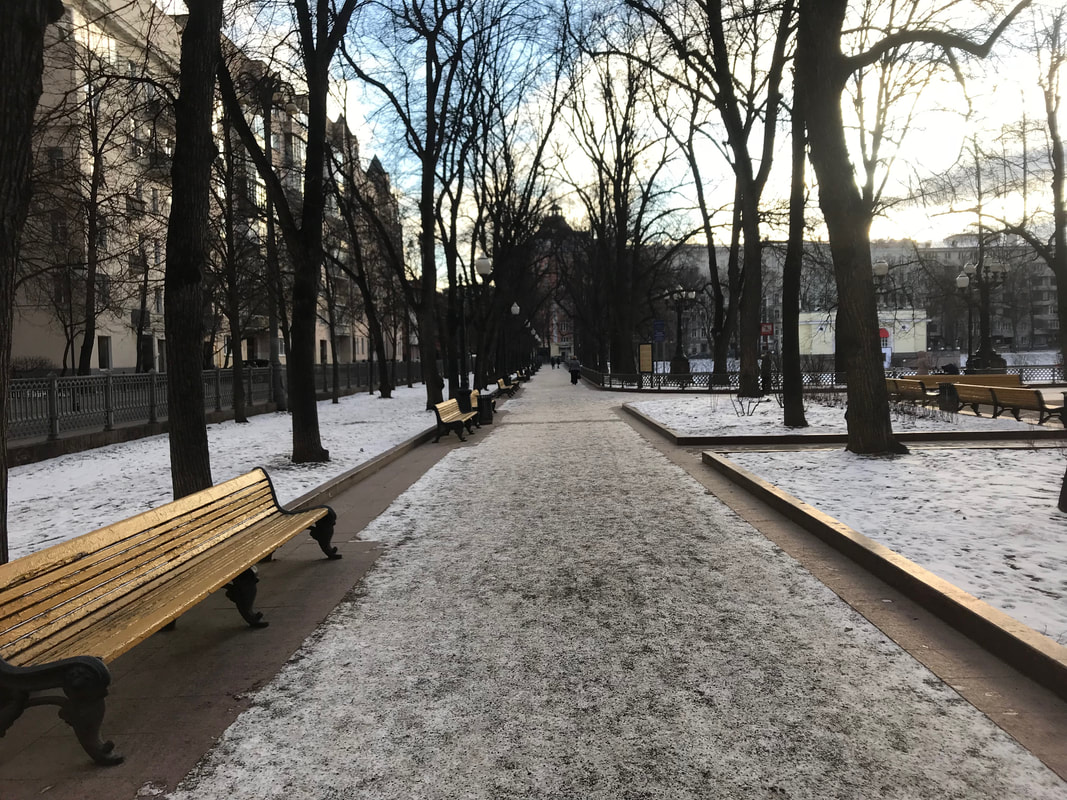 Patriarch's Pond and the famous benches! On the right is the pond, and on the left is Bronnoy Street. 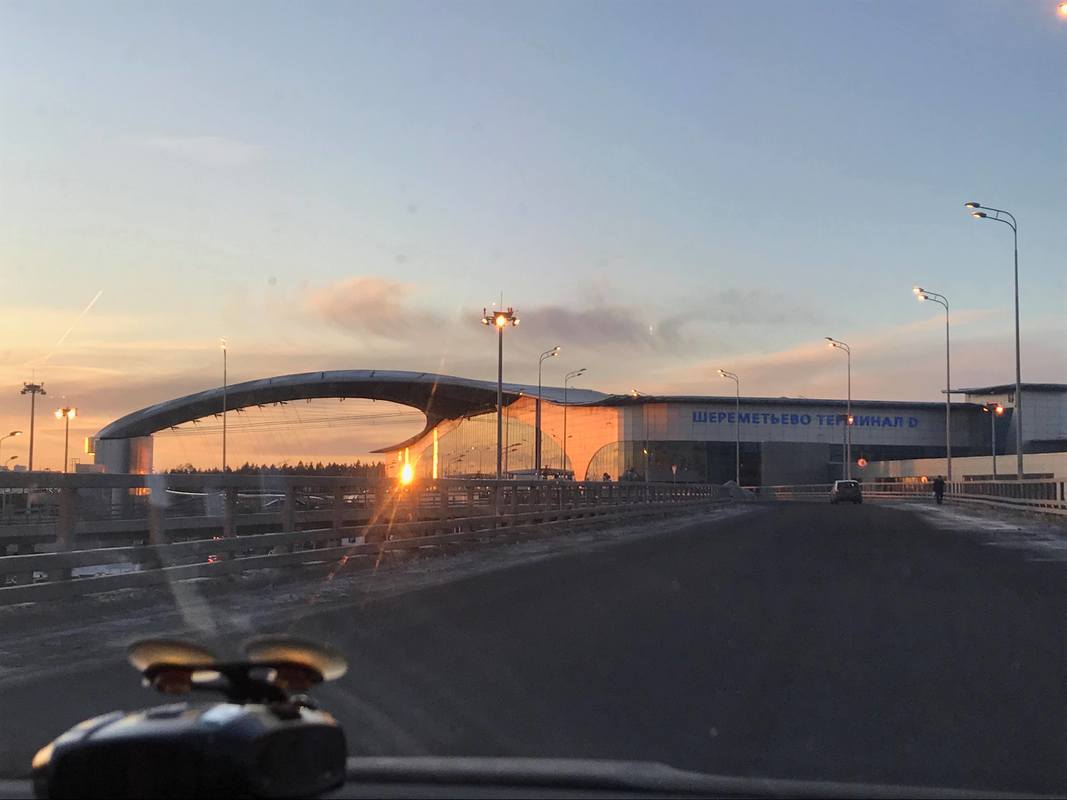 Sheremetyevo airport at sunset. Goodbye Moscow! I've marked a couple spots with arrows. The red arrow points to the trees and the Moscow River - the same view that I saw from Sparrow Hill yesterday evening. The yellow arrow points to the city center - the Red Square. You can see from the pictures the distinct pinwheel layout of Moscow. The city is built like a wagon wheel, with five concentric circles, and "spokes" connecting each of the circles.  Hello, Perm!
|


